

How to Build a Pokemon Deck for Beginners: The 2026 Pro Guide
Stop building piles and start building engines. Your deck is only as fast as your Trainer cards; if you're just stuffing 60 random favorites into a sleeve, you've already lost. We get it. It's the sting of losing every game because you can't find that one evolution you need. It's the fear of wasting cash on cards that don't work. Learning how to build a pokemon deck for beginners shouldn't feel like a chore. It should feel like a kool upgrade to your entire gaming lifestyle.
This guide is your shortcut to a legal, competitive 60-card deck that dominates the 2026 season. We're moving past the "G" mark rotation and focusing on the "H," "I," and "J" sets that matter right now. You'll master the art of the draw engine, discover why top pros often run as few as 5 to 10 Energy cards, and identify the must-have staples like Meowth ex and Fezandipiti ex. We're breaking down the exact ratios you need to turn a messy collection into a high-performance machine. You'll leave with the confidence to walk into any local league and play like a savvy curator of the meta.
Key Takeaways
- Master the 60-card limit and the Rule of Four to ensure your deck is legal, lean, and ready for 2026 tournament play.
- Ditch the 20-20-20 energy myth. Build a high-speed Trainer engine with 30+ cards to keep your hand full every single turn.
- Master how to build a pokemon deck for beginners by pairing a powerhouse "Main Attacker" with Ability-driven "Bench Sitters" for ultimate synergy.
- Use goldfishing and the Rule of 10 to test your consistency and fix dead draws before you ever step foot in a local league.
- Identify the essential starter kits and Booster Bundles that provide the most value for building your specific core strategy from scratch.
The Golden Rules of Pokemon TCG Deck Building
Forget the chaos of a random pile. Your deck is a high-speed engine. To master how to build a pokemon deck for beginners, you need to understand the structural limits that define the pro scene. It's about speed. It's about consistency. It's about owning the board from turn one. If you don't follow the blueprint, you're just playing with a stack of paper. Let's get into the math that makes a winner.
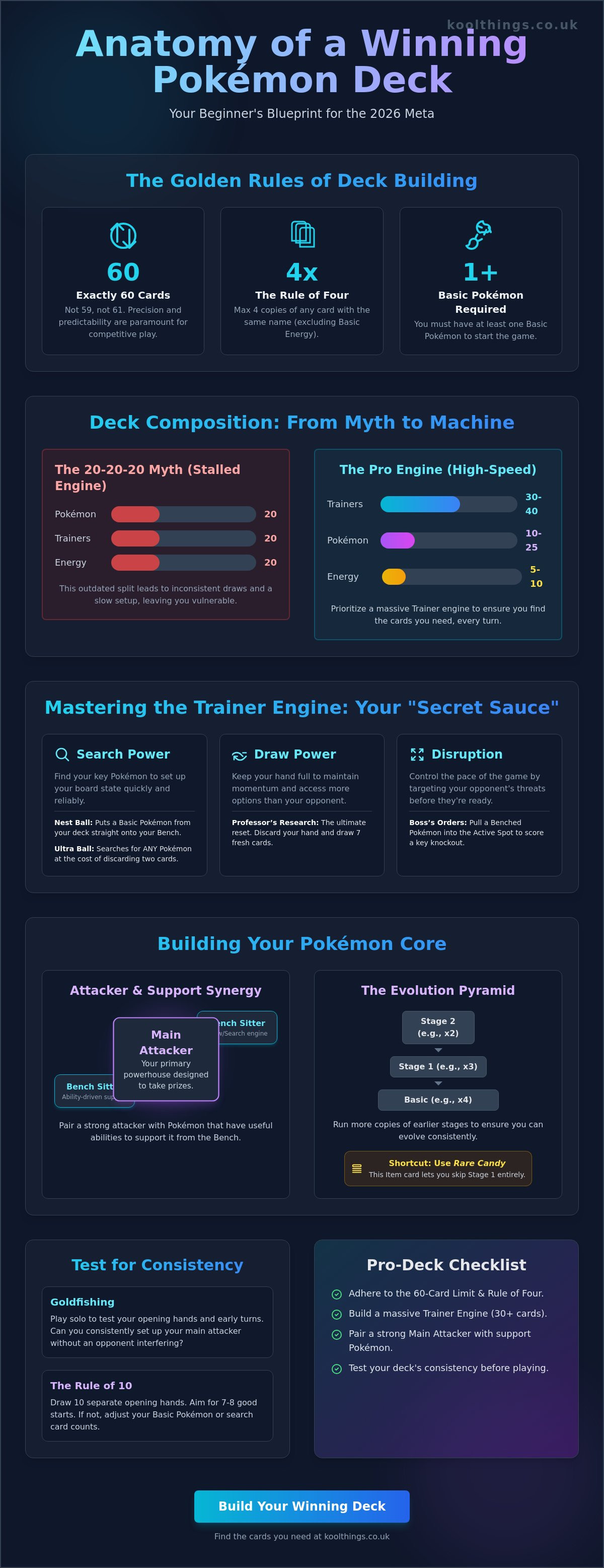
The first rule is absolute. Your deck must contain exactly 60 cards. Not 59. Not 61. This precision ensures every match is balanced and every draw is predictable. In the competitive world, this is the foundation of every championship list. According to the official Pokémon TCG rules, a legal deck consists of exactly 60 cards and can include no more than four copies of any card with the same name, excluding Basic Energy. This "Rule of Four" prevents players from simply spamming the most powerful card in the set, forcing you to think like a curator and select a variety of tools to handle different threats.
You also need a starting point. Every deck must have at least one Basic Pokemon. If you don't draw a Basic in your opening hand, you have to reveal your hand, shuffle, and draw again. This gives your opponent a free card. To avoid this, pros usually run 8 to 12 Basics. While most cards are capped at four copies, Basic Energy is the wild card. You can run as many as you like. However, modern decks are moving away from heavy Energy counts. In the 2026 meta, efficiency is king. You don't need 20 Energy if your Trainers can find exactly what you need when you need it.
The 60-Card Skeleton
Think of your deck in three distinct parts: Pokemon, Trainers, and Energy. A balanced skeleton is the secret to a fluid game. Most beginners make the mistake of a 20-20-20 split, but that's a recipe for a stalled engine. Modern pro decks are often 50 percent Trainers. These cards are the glue. They find your attackers and cycle your hand. When you're learning how to build a pokemon deck for beginners, focus on the "Rule of Four" for your most vital search cards. A legal deck is a precise 60-card machine where every piece serves a specific purpose.
Understanding Evolution Lines
Evolution is where your strategy takes flight. You should view your evolution lines as a pyramid. You always want more Basic versions than Stage 2 versions. If you run a 4-3-2 line (four Basics, three Stage 1s, and two Stage 2s), you ensure that even if a Basic gets Knocked Out early, your heavy hitter can still hit the field. It's about redundancy. For a faster pace, use Rare Candy. This card lets you skip the Stage 1 phase entirely, jumping from a Basic to a Stage 2 in a single turn. It's a bold, high-tempo move that keeps your opponent on the defensive. Whether you're hunting for evolution pieces in a Pokemon English 151 Booster Pack or a specialized bundle, always prioritize the foundation of your pyramid.
The Secret Sauce: Mastering the Trainer Engine
Forget the old-school 20-20-20 split. It is a relic of a slower era. If you want to know how to build a pokemon deck for beginners that actually stands a chance in 2026, you need to prioritize the engine. Modern decks are high-speed machines. They don't wait for the right card; they go out and find it. Most competitive lists now run 30 to 40 Trainer cards. This is the "Secret Sauce" that separates a pile of cardboard from a championship-ready deck. Trainers provide the consistency you need to execute your strategy every single game.
Search cards are your primary tools for board setup. Nest Balls and Ultra Balls are absolute essentials. A Nest Ball grabs a Basic Pokemon and puts it straight onto your bench. An Ultra Ball is even more versatile, letting you search for any Pokemon at the cost of discarding two cards. This might feel like a high price, but thinning your hand often helps you dig deeper into your deck. These cards ensure your star attackers hit the field on turn one or two. Without them, you're just hoping for a lucky draw, and hope is not a winning strategy.
Draw power is the gas in your tank. Professor’s Research is arguably the most important card you will ever own. It lets you discard your entire hand and draw seven fresh cards. It’s bold, it’s aggressive, and it’s how pros maintain momentum. Disruption is the other side of the coin. Boss’s Orders allows you to switch your opponent's active Pokemon with one from their bench. This lets you target weak supporters or high-value targets before they are ready to fight. Controlling the tempo of the match is how you turn a losing position into a win.
Supporters vs Items
The distinction between these two is vital for your turn-by-turn rhythm. You can only play one Supporter card per turn. This limitation means every Supporter in your deck must have a massive impact. Items are different. You can play as many Item cards as you want during your turn. This allows for explosive plays where you search, heal, and switch Pokemon all in one go. According to the official deckbuilding guide, balancing these card types is the first step toward a functional list. In 2026, every beginner deck needs a playset of Ultra Balls, Professor’s Research, and Boss’s Orders to remain relevant.
Why Energy is Secondary
Many new players fall into the trap of "Energy Flooding." This happens when your hand is full of Energy cards but you have no way to attack or draw new cards. It’s a frustrating way to lose. While it feels counterintuitive, you actually need fewer Energy cards than you think. Most modern decks thrive on just 8 to 12 Energy cards. Instead of stuffing your deck with Basic Energy, use "Energy Search" or "Nightstretcher" to grab what you need from the deck or discard pile. This keeps your deck lean and increases the odds of drawing into a game-changing Trainer. If you're ready to start hunting for these high-utility cards, picking up a Pokemon English 151 Booster Pack is a brilliant way to build your staple collection.
Picking Your Star: Building Around a Core
Building a deck is about more than just raw power. It is about curation. You are the architect of a strategy, and every architect needs a foundation. When you are learning how to build a pokemon deck for beginners, you must start with a "Core." This is the heart of your 60 cards. It defines how you play, how you win, and how your deck feels on the table. Don't just throw in every cool card you find. Select a star and build a world around it.
Follow this five-step framework to turn a collection of cards into a high-performance engine:
- Step 1: Choose your Main Attacker. This is usually a high-HP Pokemon ex that can take hits and dish out massive damage. In the 2026 meta, cards like Meowth ex are popular because they offer both power and utility.
- Step 2: Add Bench Sitters. These are Pokemon with helpful Abilities that stay on the bench to support your star. Think of Fezandipiti ex, which provides crucial draw support without ever needing to enter the active spot.
- Step 3: Match your Energy. Your Energy count must cater specifically to your Main Attacker’s attack costs. If your star needs two Fire Energy, your deck needs to be able to find them fast.
- Step 4: Fill the gaps with Tech. Tech cards are specific Trainers or Pokemon added to counter popular decks in the local scene. If everyone at your league plays Water decks, add a "tech" attacker that hits for Lightning weakness.
- Step 5: Test and tweak. No deck is perfect on the first try. Play games, see which cards stay stuck in your hand, and swap them out for something more useful.
This structured approach is backed by the Official Pokémon TCG Deck-Building Guide, which emphasizes the importance of synergy over individual card strength. A deck that works together will always beat a deck of disorganized "powerhouse" cards.
Building Around Pokemon 151
The Pokemon English 151 Booster Pack set is the ultimate starting point for beginners. It combines the nostalgia of the original Kanto favorites with modern power levels. You can build iconic cores around heavy hitters like Charizard ex or Blastoise ex. These decks are straightforward, effective, and incredibly satisfying to play. Starting with 151 allows you to learn the mechanics with characters you already know and love, making the transition to competitive play feel natural and inspired.
The Power of Type Synergy
Sticking to one or two types makes your Energy management much easier. If you mix too many types, you'll constantly find yourself with the wrong Energy at the wrong time. Understanding the "Rock, Paper, Scissors" of Weakness and Resistance is vital for survival. To cover your main Pokemon's weakness, choose a secondary type that hits the attackers your star fears most for super-effective damage. This ensures that even your "bad" matchups remain winnable through smart curation of your secondary attackers.
The Koolthings Beginner Checklist
You have the blueprint. You know the engine. Now, you need the gear. Learning how to build a pokemon deck for beginners is about the cards, but it is also about the lifestyle. High-quality gear elevates your game. It turns a messy pile into a professional setup. If you are going to invest time into curation, you need to protect that investment with the right tools. It is the difference between a casual hobbyist and a savvy trainer.
Elite Trainer Boxes (ETBs) are the ultimate "Deck in a Box" starter kit. They provide the essentials in one vibrant package. You get 45 Basic Energy cards, themed dice, condition markers, and a set of sleeves. It is a one-stop shop for building your foundation. If you are hunting for specific "hits" to complete your core, Booster Bundles are your best friend. They offer a high density of packs without the extra fluff. They are designed for the player who knows exactly what they are looking for.
Essential Gear for New Trainers
Protection is non-negotiable. The "shuffle scuff" is real, and it kills card value. When choosing sleeves, you have two main paths: Matte or Glossy. Matte sleeves are the pro choice for a reason. They offer a textured back that makes mash-shuffling feel smooth and rhythmic. Glossy sleeves look incredible and make your holos pop, but they can get sticky during a high-tempo match at a local league. Choose what feels best for your hands.
A dedicated deck box is essential. Never use a rubber band. It damages the edges and ruins the aesthetic of your curated selection. A sturdy box keeps your 60-card machine safe in your bag. For your high-value "Secret Rares" or alternate arts, use top-loaders when they aren't in your deck. It keeps them pristine while you show them off to your community. This level of care reflects a brand of play that values individuality and quality.
Where to Start Your Hunt
The thrill of the pull is what keeps the innovation landscape of the TCG so exciting. Integrating a "Rare Holo" into your first deck makes it feel unique. We believe in the power of personalized selection. Hand-picked packs often feel more rewarding than random bulk. You can check out our latest Pokemon 151 stock to find your core attackers and start your journey with the most iconic characters in the game.
Don't forget the playmat. A smooth, clean surface protects your sleeves and makes picking up cards effortless. It defines your space at the table and shows you are serious about the game. It is about fluid functionality and modern design. Ready to upgrade your entire gaming routine? Pick up a Pokemon English – 151 – Booster Pack or a Mystery Box today and start building.
From Pile to Pro: Testing and Community
Your 60-card machine is sleeved and ready. But is it fast enough? Curation is only half the battle. Testing is where you prove your strategy actually works. Pros use a method called "goldfishing" to refine their lists. You play against an imaginary opponent to see how quickly your engine sets up. It is about rhythm and tempo. If you cannot hit your main attacker by turn two, your engine is stalling. Goldfishing helps you find the flow of your deck before you ever step into a competitive arena.
Use the "Rule of 10" to verify your consistency. Shuffle your deck and draw 10 separate opening hands. If you don't draw a Basic Pokemon in all 10 test hands, your ratios are broken. This is a non-negotiable step in how to build a pokemon deck for beginners. Consistency is the bridge between a casual pile and a pro list. Once your deck passes the test, find your local UK vibe. Local leagues are the heart of the hobby. They are where you test your "tech" cards against real-world threats and find a community that shares your passion for high-quality play.
Refining Your Strategy
Pay close attention to "Dead Cards" during your matches. These are the cards that sit in your hand game after game because they are too situational. If a card isn't helping you win, it's taking up space. You might need to swap a niche Item for more draw power or a heavier damage modifier. Evolving your deck is a constant process. Keeping up with the 2026 meta doesn't require a massive budget. It requires being a savvy curator of the cards you already own. Focus on fluid functionality and watch how your playstyle shifts as you gain experience.
The Collector Lifestyle
Deck building is just the entry point to a much larger world. This hobby is a lifestyle. You'll soon find yourself balancing playability with collectibility. Your binder becomes a curated gallery of your journey through the sets. While you organise your new deck and hunt for those rare 151 hits, check out our Funko Pop Steve Harrington guide for more collector vibes. It is about owning unique items that reflect your personality. From your deck box to your display shelf, every choice defines your personal aesthetic. Stay rebellious against the mundane nature of mass-market retail. Keep evolving. Keep winning.
Dominate Your First League Match
You've moved past the pile and built a true engine. You now understand that the Rule of Four and a massive Trainer-to-Energy ratio are the real secrets to a high-speed game. Mastering how to build a pokemon deck for beginners is about more than just cardboard; it's about the confidence to execute your strategy under pressure. You've tested your draws with the Rule of 10. You've protected your hits with matte sleeves. Now, you just need the raw power to finish the job and take your place in the community.
We are a family-run business with a genuine passion for the hobby. We've expertly curated a selection of the latest sets to ensure you only get the best. With UK-wide shipping on all Pokemon TCG products, your next game-changing hit is just a click away. Upgrade your deck with the latest Pokemon 151 Boosters at Koolthings!
The local league is waiting for a fresh face. Your curated 60-card machine is ready to shine on the playmat. Go out there, stay rebellious, and claim your first victory.
Frequently Asked Questions
How many Pokemon should be in a beginner deck?
Learning how to build a pokemon deck for beginners starts with a count of 12 to 18 Pokemon. This range provides a solid balance between your main attackers and the support cards needed to keep them in the fight. If you pack too many, you won't have room for the vital Trainers that make your strategy move. It's about quality over quantity. Redundancy. Precision. Focus on a tight line of evolutions rather than a chaotic crowd of random favorites.
Can I mix different generations of Pokemon cards in one deck?
You can mix cards from any era as long as they have a legal regulation mark for the current Standard format. In the 2026 season, you'll be looking for "H," "I," and "J" marks in the bottom corner. This allows you to combine modern powerhouses with iconic characters from sets like the Pokemon English – 151 collection. Just ensure the card names and text are up to date with current rulings. It's a blend of heritage and high-tempo innovation.
What is the best Pokemon set for beginners to buy in 2026?
The Pokemon English – 151 set remains the premier choice for anyone starting their collection. Iconic. Powerful. Straightforward. It features legendary favorites with modernized mechanics that are easy to grasp but hard to beat. These cards provide a fantastic foundation for a competitive core. Buying a Booster Pack or a specialized bundle from this set ensures you're getting high-value hits that look incredible and play even better. It's the ultimate curated experience.
Do I really need 60 cards to play Pokemon TCG?
Yes, every legal deck must contain exactly 60 cards. This is a strict requirement for tournament play and local league matches alike. Not 59. Not 61. Having a fixed number ensures that the game remains balanced and that every player has the same mathematical odds of drawing their key cards. It's about game balance and fairness. If you're even one card off, you'll need to adjust your list before the game begins.
What are Trainer cards and why are they important?
Trainer cards are the engine of your deck. They allow you to search for specific Pokemon, draw fresh hands, and heal your active attackers. Without a high count of Trainers, your deck will feel slow and clunky. Modern pro decks often run 30 or more Trainers to ensure they can execute their game plan every single turn. They are the tools that turn a pile of cards into a winning strategy. Fast. Fluid. Essential.
How do I know if my Pokemon deck is legal for tournament play?
Check the regulation mark in the bottom-left corner of each card. As of April 10, 2026, cards with the "G" mark have rotated out of the Standard format for in-person events. To play in official matches, your deck should only feature cards with "H," "I," "J," or later marks. This rotation keeps the game fresh and ensures that the meta is constantly evolving with new developments. Always stay ahead of the curve.
Is it better to buy a pre-made deck or build my own?
Building your own deck is the best way to master how to build a pokemon deck for beginners. While pre-made decks are a quick way to start playing, they often lack the speed and focus of a custom build. Creating your own list allows for personalized selection and lets you "tech" in cards that counter your local rivals. It turns the game into a true expression of your individual style and tactical eye. Rebellion against the mundane.
How much Energy should I put in my first deck?
Stick to 8 to 12 Energy cards for a modern, high-tempo deck. It feels tempting to add 20 or more to ensure you always have some, but this often leads to "dead hands" where you can't do anything but pass. Instead, use Trainer cards like Nest Balls or Energy Search to pull the exact Energy you need from your deck. This keeps your build lean and ensures you're always drawing into action rather than just resources. Efficiency is king.