

How to Build a Pokemon TCG Deck for Beginners: The 2026 Strategy Guide
The classic 20-20-20 rule is officially dead; if you're still building decks like it's 1999, you're going to lose. Learning how to build a pokemon tcg deck for beginners in 2026 means ditching the clutter and focusing on high-speed synergy. It's easy to feel overwhelmed by technical jargon or the fear of accidentally bringing an illegal G regulation card to your local UK league. You want a deck that flows, not a pile of cards that gets stuck in your hand while your opponent sweeps the board. Simple. Powerful. Kool.
We've got you. This guide cuts through the noise to help you master the art of deck building with a snappy, expert strategy. You'll learn how to assemble a legal 60-card masterpiece using the current H, I, and J regulation marks while nailing the perfect card ratios for the modern meta. We're breaking down everything from the rise of Mega Evolution Pokémon to the essential Trainer engines that keep your game moving. By the end, you'll have the confidence to walk into any event with a winning list built from scratch.
Key Takeaways
- Nail the 2026 fundamentals by mastering the strict 60-card requirement and the essential four-copy limit for legal Standard play.
- Discover the expert blueprint for how to build a pokemon tcg deck for beginners using a high-tempo ratio of 15 Pokemon, 33 Trainers, and 12 Energy.
- Choose your path between a streamlined mono-type strategy for energy efficiency or an advanced ability-driven engine for maximum synergy.
- Follow our curated roadmap to build around your favorite "Star" Pokemon and create a competitive list ready for any local UK league.
- Grab your Pokemon 151 Booster Packs and hand-picked accessories from Koolthings to ensure your new deck looks as sharp as it plays.
The Golden Rules of Pokemon TCG Deck Building
Building your first deck feels like cracking a fresh pack. Pure excitement. But before you stack your favourite heavy hitters, you need to know the hard limits. Mastering how to build a pokemon tcg deck for beginners starts with three non-negotiable rules. These aren't just suggestions. They are the difference between a winning setup and an illegal list that gets you disqualified at your local UK tournament. The Pokémon Trading Card Game thrives on these boundaries to keep matches fair and fast.
The 60-Card Foundation
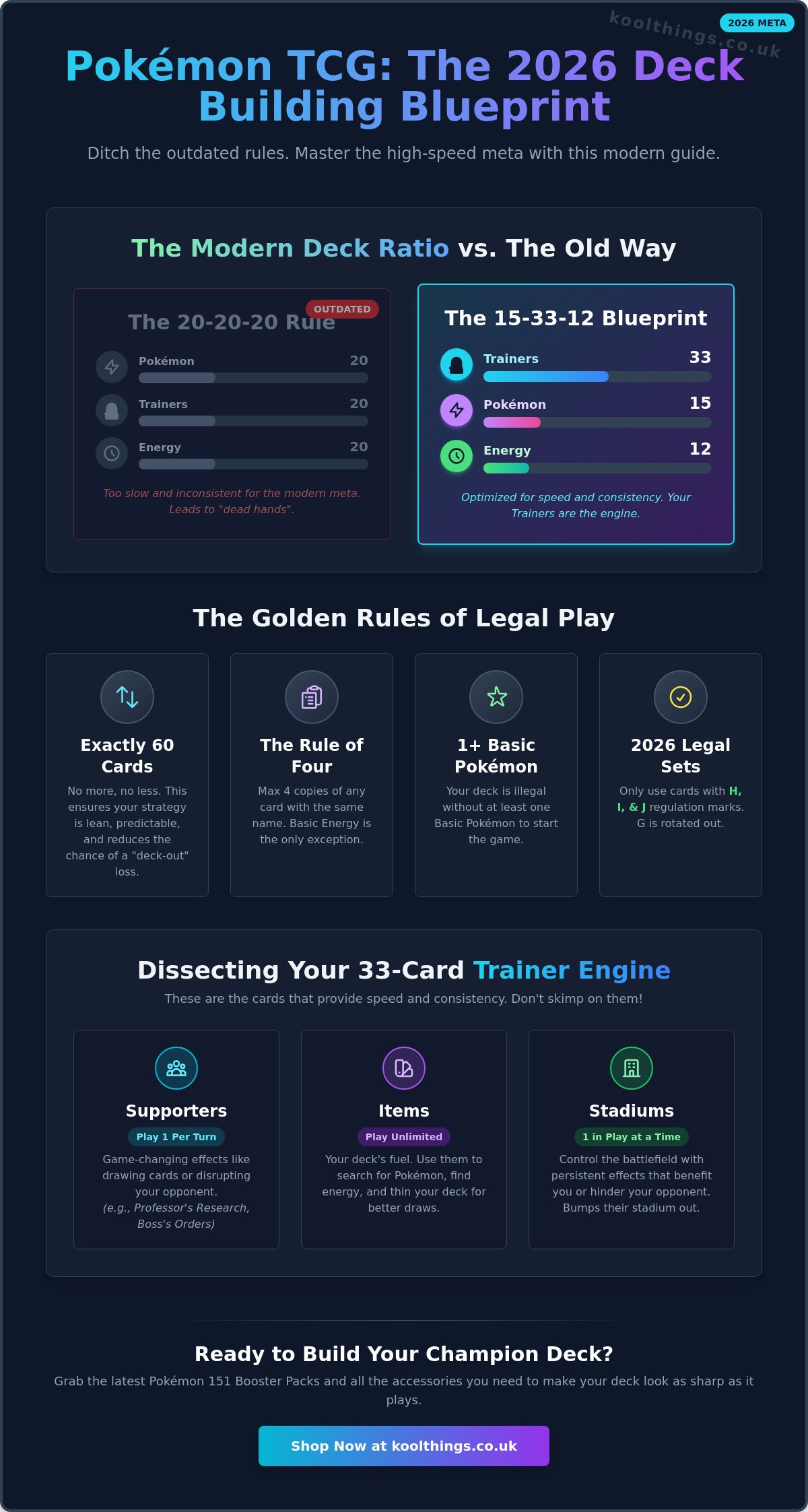
Exactly 60 cards. No more. No less. This strict count ensures your strategy stays lean and predictable. If you pack 100 cards, you'll never draw the one you actually need. Then there is the "deck-out" factor. If you can't draw a card at the start of your turn because your library is empty, you lose immediately. It's that simple. A legal deck for 2026 competitive play must be exactly 60 cards using only H, I, and J regulation marks.
The Rule of Four
You can't just run 20 copies of your strongest card. The Rule of Four states you can only have four cards with the same name in your deck. This applies to Pokemon and Trainer cards alike. Basic Energy cards are the only exception; you can run as many of those as your strategy requires. Be careful with naming conventions. A Pikachu and a Pikachu ex have different names, so you can run four of each. Learning how to build a pokemon tcg deck for beginners means knowing when to max out these copies to ensure you draw your best cards every single game.
Don't forget the most basic requirement. You must include at least one Basic Pokemon. Without it, you can't even set up your opening hand. For the 2026 season, keep your cards legal by checking the bottom left corner for that H, I, or J mark. Anything with a G mark is now officially rotated out of Standard play. Stick to these golden rules. Your deck will be legal, lethal, and ready for the local league.
The Magic Ratio: Balancing Pokemon, Trainers, and Energy
Forget the old school "20-20-20" split. That's a relic of the past. If you want to win in the 2026 meta, you need a deck that moves with purpose. Understanding how to build a pokemon tcg deck for beginners starts with mastering the "Golden Ratio." For most modern builds, you should aim for 15 Pokemon, 33 Trainers, and 12 Energy cards. This specific blueprint ensures you always have the right tools in hand without the clutter. While your Pokemon are the stars of the show, your Trainer cards are the high-performance engine that makes everything run. Without a heavy Trainer count, your deck will stall before you even take your first Prize card.
A common rookie mistake is loading up on 20 or more Energy cards. It feels safe, but it's actually a trap. Too much Energy leads to "dead hands" where you have nothing to play but attachments. High-tempo decks in 2026 typically include only 8 to 12 Energy cards because they use sophisticated Trainer engines to find exactly what they need. If you're looking to stock up on the latest staples, you can find everything from Pokemon 151 Booster Packs to elite accessories at Koolthings to help you hit these precise ratios.
Trainers: The Secret to Speed
Your Trainers are divided into Supporters, Items, and Stadiums. Supporters are powerful cards like Professor’s Research or Boss’s Orders, but you can only play one per turn. Items are your unrestricted fuel; you can play as many as you want to thin your deck and find your "Star" Pokemon. According to the official guide to deckbuilding, consistency is the goal. Use Stadium cards to flip the board in your favour, bumping your opponent's active effects and controlling the flow of the match. If your deck isn't drawing at least two or three cards every turn, you need more Trainers.
Refining Your Energy Count
Calculating your Energy needs isn't just about total numbers. Look at your main attacker’s costs. If your heavy hitter needs three Energy to swing, you'll need ways to "accelerate" those attachments. Special Energy cards add utility, providing extra damage or protection, but remember they still count toward your 60-card limit. There is also a tactile joy in building. Matching your basic Energy cards to your deck’s aesthetic or using premium foil versions makes every draw feel like a win. Keep it lean. Keep it fast. That is how to build a pokemon tcg deck for beginners that actually stands a chance at a local UK league.
Choosing Your Strategy: Type vs. Ability
Your strategy is the soul of your deck. It is where your personal style meets the 2026 meta. When you are figuring out how to build a pokemon tcg deck for beginners, you will usually land on one of two paths: raw elemental power or complex ability chains. Every top tier build starts with a "Main Attacker." This is your heavy hitter, the card you want in the Active Spot as often as possible. But do not overlook your "Bench Sitters." These Pokemon never actually attack. They sit on the sidelines, using their Abilities to draw cards, move Energy, or protect your heavy hitters from damage. Balancing these roles is the secret to a deck that feels fluid and unstoppable.
Building Around One Type
Mono-type builds are the speed demons of the TCG. By focusing on a single element like Fire, Water, or Grass, you ensure every Energy card in your deck is always useful. In the 2026 season, Fire decks remain explosive by utilizing type-specific support Trainers that accelerate attachments. While Magma Basin was a staple of the past, modern H, I, and J regulation cards offer fresh ways to keep your Fire types burning bright. The trade off? Weakness. A mono-Water deck will crumble against a Lightning opponent if you do not have a plan. Smart builders use "Tech" cards, specific items or secondary attackers, to cover their deck’s Achilles’ heel and keep the pressure on.
The Power of Synergy
Ability-driven strategies are for the tacticians. Instead of relying on one element, you pair Pokemon based on how their powers interact. You might pair a high damage "ex" attacker with a support Pokemon that has an Energy acceleration Ability. This creates a loop where you are never left without an attack. This in-depth deck-building guide highlights how consistency is built through these connections. "Vibrant Synergy" is the hallmark of a Koolthings-approved deck. It is about making different cards feel like they belong together. When your Bench Sitters are constantly feeding your Active Pokemon, you are not just playing cards. You are running a high performance machine. Mastering this synergy is the ultimate step in how to build a pokemon tcg deck for beginners who want to dominate their local UK league.
The Step-by-Step Beginner Build Roadmap
You have the rules. You have the ratios. Now, it is time to build. This is the moment where your collection transforms into a competitive force. Learning how to build a pokemon tcg deck for beginners is a bit like assembling a high-performance engine piece by piece. You don't just throw cards together and hope for the best. You follow a logical flow that ensures every draw moves you closer to a win. It is a process of curation, testing, and refinement that turns a pile of cardboard into a strategic masterpiece.
Identifying Your Core
Every great deck starts with a "Star." This is the primary Pokemon that will do the heavy lifting in your matches. Usually, you want to select 2 to 3 copies of your primary "ex" or "V" Pokemon to ensure they show up in your opening hands or early draws. If your Star is an Evolution Pokemon, the "evolution pyramid" is your best friend for consistency. A classic beginner setup is the 4-1-3 ratio: four of the Basic form, one of the Stage 1, and three of the Stage 2. This structure accounts for the fact that your smaller Pokemon are vulnerable early on. Choose your first card based on its ability to deliver a massive knockout or its power to disrupt your opponent’s entire game plan.
The Search and Draw Engine
Once your core is locked in, you need to find those pieces fast. A deck that stalls is a deck that loses. This is why search Items like Nest Ball and Ultra Ball are non-negotiable for beginners. They act as the glue for your strategy, allowing you to pull specific Pokemon from your deck exactly when you need them. You also need to master "discard and draw" mechanics. Cards that force you to discard your hand to draw seven new cards might feel risky, but they are essential for thinning your deck and finding your win conditions. Momentum is everything in the 2026 meta.
After you have layered in your engine, fill the remaining gaps with "Tech" cards. These are your silver bullets; single copies of cards designed to handle specific matchups or provide a surprise utility. Finally, add your Energy and get to the table. Playtesting is the final, vital step. Take your build through at least three games and watch for "dead" cards that stay in your hand. If a card isn't helping you win, swap it out. If you are looking for that one missing piece to complete your roadmap, grab a Pokemon English - 151 - Booster Pack and see what high-impact cards you can add to your rotation. This iterative loop is the real secret to how to build a pokemon tcg deck for beginners that stands the test of a local UK league night.
Curating Your Deck with Koolthings Style
Building a deck is a curated hunt for synergy. It is about more than just numbers on a page. At Koolthings, we get it. We are not just a shop; we are your UK destination for hand-picked Pokemon TCG essentials. Every booster pack and accessory in our collection is chosen with the same care you put into your 60-card masterpiece. Whether you are hunting for that elusive "ex" card or looking for the perfect sleeves to protect your investment, we offer a selection that matches your ambition. Understanding how to build a pokemon tcg deck for beginners is just the start. The real magic happens when you hold those high-quality cards in your hands.
Beyond the cards themselves, the way you present your deck matters. Premium sleeves and mats aren't just for show. They elevate your daily routine from a simple game to a lifestyle aspiration. We curate our Pokemon 151 and booster stock for real players who value both design and utility. Join our community of savvy collectors. Move away from the mundane nature of mass-market retail and embrace a voice that feels fresh and inspired.
The Koolthings Advantage
Expert curation is our core. We only stock what we would play ourselves. As an independent, family-run business, our passion for the TCG hobby runs deep. We know that when you are learning how to build a pokemon tcg deck for beginners, you want your components immediately. Our fast UK shipping ensures you spend less time waiting and more time playtesting your new strategy. This is about fluid functionality and industry-leading status. We speak with the authority of a knowledgeable friend who is always ahead of the curve.
Next Steps for Your Collection
Your journey doesn't stop at the table. Elevate your space and your collection with items that reflect your personal aesthetic. If you are a fan of iconic characters, complement your deck with our Steve Harrington Funko Pop guide to see how we curate across all our favourite fandoms. Ready to find your next "Star" card? Explore our curated booster packs, including the legendary Pokemon 151 series, to find the heavy hitters your deck is missing. The 2026 meta is moving fast. Stay ahead. Shop our full Pokemon collection now! and experience the joy of owning something unique.
Own the Arena with Your Custom Build
You have the blueprint. You've mastered the 60-card foundation and the high-speed Trainer engine. You know how to pair your "ex" stars with the right bench support to keep the pressure on. Mastering how to build a pokemon tcg deck for beginners is about more than just following a list. It is about curating a strategy that feels like you. It is about that tactile rush when you draw exactly what you need to close the game. Your next win starts with the right components.
Don't settle for mundane, mass-market leftovers. At Koolthings, we are family-run independent hobby specialists with a sharp eye for quality and design. We offer an expertly curated UK inventory of the latest sets and essentials. With our fast, reliable national shipping, your new deck-building components will arrive before your next local league night. Build your ultimate deck with our curated Pokemon collection!
The 2026 season is yours to dominate. Grab your cards, shuffle up, and show the arena what a truly curated deck can do. It's time to play.
Frequently Asked Questions
How many cards do I need to build a Pokemon deck?
A legal Pokemon deck must contain exactly 60 cards. No more, no less. This strict requirement is a cornerstone of the game's balance. It ensures that every player has the same probability of drawing their key cards. If you're building for a local UK event, having even one card too many will result in disqualification. Keep your count precise to keep your strategy sharp, consistent, and completely legal for tournament play.
Can I have more than four of the same Pokemon in my deck?
You are limited to four copies of any card with the same name. This rule keeps the game varied and prevents players from stacking too many identical power cards. It applies to Pokemon and Trainers alike. For instance, you can run four Pikachu and four Pikachu ex because they have different names. Basic Energy cards are the only ones you can include in any quantity you like to fuel your attacks.
What is the best ratio of Pokemon to Trainers and Energy?
For the 2026 meta, the most effective ratio is 15 Pokemon, 33 Trainers, and 12 Energy. This setup moves away from older, slower builds that used too much Energy. It places a massive emphasis on your Trainer engine to keep your hand full of options every turn. Mastering how to build a pokemon tcg deck for beginners means trusting your Trainers to find the Energy you need rather than packing your deck with unnecessary cards.
Do I need to use the same type of Pokemon in one deck?
You can mix different types, but mono-type decks are often more efficient for new players. Sticking to one element, like Fire or Water, makes your Energy attachments straightforward and fast. However, many modern strategies pair different types that share powerful Abilities for better synergy. If you choose to go multi-type, just make sure your Trainer cards are curated to search for the specific Energy required by your diverse attackers to avoid getting stuck.
What are Trainer cards and why are they important?
Trainer cards are the high-tempo engine that powers your entire game. They are split into Supporters, Items, and Stadiums. Supporters like Professor’s Research provide massive draw power, while Items like Ultra Ball help you find specific Pokemon instantly. Without a heavy count of at least 30 Trainers, your deck will likely stall during a match. They are essential for thinning your deck and reaching your win condition before your opponent has a chance to react.
Can I use older Pokemon cards in a new deck in 2026?
You can only use older cards if they feature the H, I, or J regulation marks required for the 2026 Standard format. Cards marked with a G or earlier have officially rotated out of competitive play. This keeps the game fresh and ensures new strategies remain relevant for all players. Always check the bottom left corner of your cards before heading to a UK tournament to ensure your collection is up to date and legal.
What is a Basic Pokemon and why do I need one?
A Basic Pokemon is any card that can be played directly from your hand to the Bench without needing to evolve first. You must have at least one Basic Pokemon in your deck to start a match. If you don't draw a Basic in your opening seven cards, you have to shuffle and try again. Most expert builders recommend running 8 to 12 Basic Pokemon to ensure a smooth, consistent start in every single game.
How do I know if my Pokemon deck is legal for play?
Your deck is legal if it has exactly 60 cards and uses only H, I, and J regulation marks. You also need to stick to the four-copy limit for cards with the same name. Understanding how to build a pokemon tcg deck for beginners involves double checking these requirements before any official match. If your deck meets these criteria and includes at least one Basic Pokemon, you're ready to play at home or in a competitive UK league.