

How to Read Manga for the First Time: The Ultimate Beginner’s Guide (2026)
What if the secret to unlocking the world's most explosive stories was simply unlearning everything you know about reading? Learning how to read manga for the first time often feels like trying to solve a puzzle while the pieces are moving. It isn't just about reading "backwards." It's a high-speed, cinematic experience that requires a totally different visual rhythm.
It's completely normal to feel overwhelmed. Nobody wants to feel "stupid" for getting lost in a panel or accidentally hitting a major spoiler because their eyes jumped the wrong way. With the global manga market projected to hit over $23 billion by the end of 2026, there has never been a better time to join the community. We promise to help you master the right-to-left flow and decode the unique language of Japanese comics in just a few minutes.
This guide breaks down exactly how to follow the action without the headache. We will explore the essential genre terms you need to know, from high-octane Shonen to deep Seinen. By the end, you'll be ready to pick up your first volume of Witch Hat Atelier or Jujutsu Kaisen and read with total confidence.
Key Takeaways
- Flip the script and master the right-to-left flow by starting at the "back" of the book. It's the essential first step to reading like a pro.
- Stop spoilers before they start. Learn to navigate panels with vertical priority so your eyes always land on the right beat.
- Decode the terminology. Discover how to read manga for the first time by matching your vibe to high-energy Shonen or artistic Shojo categories.
- Go tactile. Experience why physical tankobon volumes beat digital every time with superior art preservation and that unmistakable new-book feel.
- Curate your shelf. Find your next obsession within an expert selection of manga novels designed for the modern collector.
The Golden Rule: Mastering Right-to-Left Reading
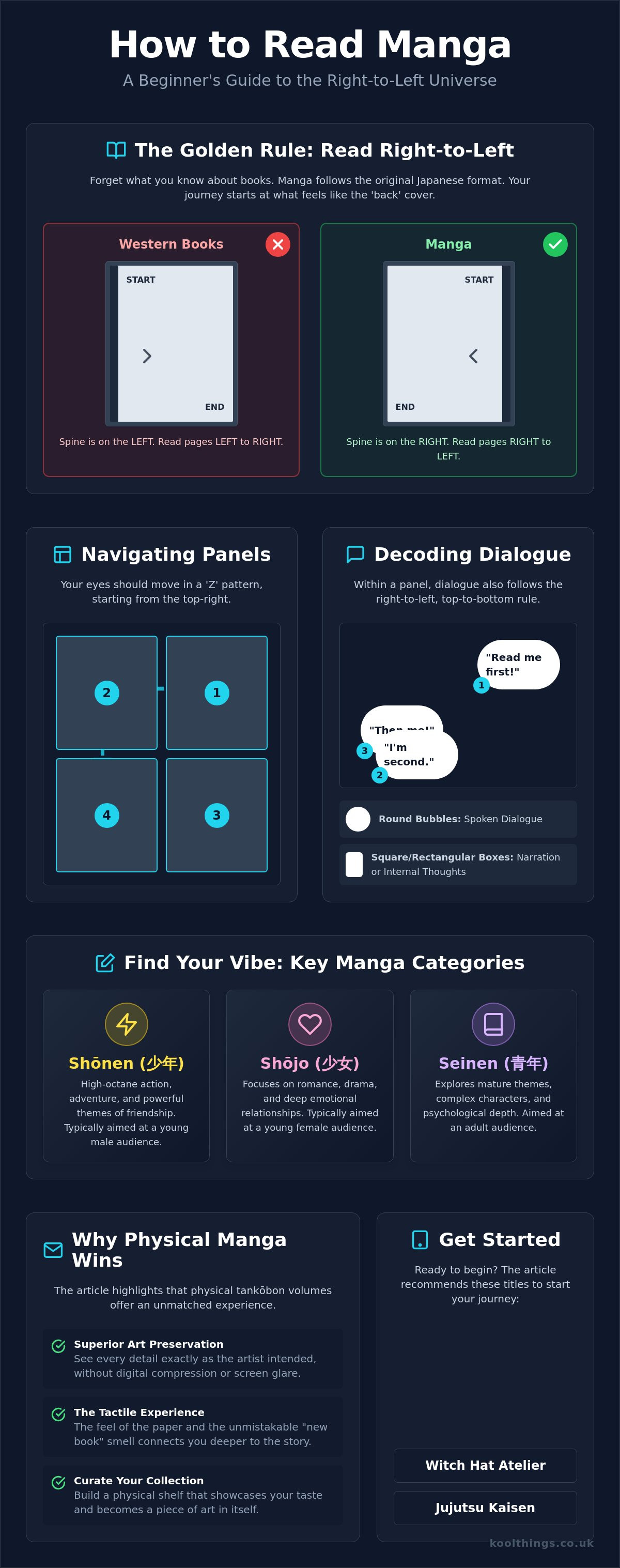
Forget everything you know about opening a book. The first hurdle when learning how to read manga for the first time is the physical orientation. In Japan, stories flow from right to left. This isn't just a quirk. It is the foundation of the entire medium. When you grab one of the latest Manga Novels, you are holding a piece of art designed to be experienced in a specific direction. Pushing against that flow is like trying to watch a movie in reverse. It just doesn't work.
The Spine and the Cover
Look at the spine. For a standard Western novel, the spine sits on the left. For manga, it sits on the right. This means the front cover is actually where you would expect the back to be. If you flip it open the Western way, you will likely encounter a warning page. These pages are legendary. They often feature a character pointing at you, telling you to turn the book around. It's a rite of passage. To truly grasp What is Manga?, you must embrace this "backwards" start. It keeps the original artwork exactly as the creator intended, ensuring every sword swing and emotional close-up hits with maximum impact.
The Horizontal Flow
Now, look at the panels. Your eyes shouldn't start at the top-left. Instead, anchor your gaze in the top-right corner. Read that first panel, then move your eyes to the left. Once you finish the top row, drop down to the next one. Again, start on the right side. It is a constant right-to-left sweep. Think of it as a zig-zag that guides you through the story. Mastering how to read manga for the first time requires training your eyes to ignore years of left-to-right habits.
Try this simple exercise on any page:
- Start: Find the panel in the uppermost right-hand corner.
- Sweep: Move your eyes to the panel directly to its left.
- Drop: Move down to the next tier of panels.
- Repeat: Start on the right side of that new row and move left again.
It feels alien for the first few minutes. Then, suddenly, it clicks. Your brain adapts to the rhythm. The cinematic flow takes over. You are no longer just looking at pictures; you are moving through a high-speed storyboard. This right-to-left rule applies to every single page, from the epic double-page spreads to the smallest character reactions. Once you nail the horizontal sweep, you have already conquered the biggest obstacle in the manga world.
Navigating Panels and Speech Bubbles
Mastering the right-to-left sweep is just the beginning. To truly understand how to read manga for the first time, you need to respect the vertical hierarchy. Gravity rules the page. If two panels are stacked, you always read the top one first. Think of it as a tiered system. You clear the top row entirely before your eyes descend to the next level of the story. This prevents you from accidentally skipping a crucial plot point or ruining a punchline. It’s a precise visual choreography that ensures the narrative beats land exactly when the artist intended.
Pay close attention to the "gutters." These are the white spaces between frames. They aren't just empty gaps. They represent the passage of time. A thin gutter might mean a split second has passed. A thick, dark gutter? That's a major time jump or a dramatic shift in location. Understanding this silent rhythm is key to appreciating the culture of manga and its sophisticated storytelling. Sometimes panels overlap or bleed into the edges of the page. When one frame breaks the grid, it usually signals simultaneous action or an intense emotional peak that can't be contained by a simple box.
Speech Bubble Hierarchy
Within a single panel, the "Right-Top" rule remains your best friend. Start with the highest bubble on the right side. If bubbles are stacked vertically, read them from top to bottom. It’s a natural flow once you get used to it. Spoken dialogue usually sits in standard round bubbles. Internal monologues? Those often appear in square boxes or bubbles with soft, cloud-like edges. This distinction helps you track what a character says versus what they are actually thinking. If you're looking for a series to practice these skills, check out the hand-picked Manga Novels in our collection.
Decoding Visual Shorthand
Manga uses a unique visual alphabet that speaks louder than words. Those "speed lines" aren't just decoration. They dictate the direction and intensity of every movement, from a subtle hand gesture to a planet-shattering punch. You'll also encounter iconic symbols that define how to read manga for the first time without getting confused. A throbbing cross on a forehead is an "anger vein." A giant blue teardrop on the back of a head is the classic "sweat drop" of embarrassment. Even the shading matters. Heavy black ink creates a sense of dread or noir-style tension, while light screentones keep the atmosphere airy and comedic. These tiny details are the "cinematic language" that makes every volume feel like a blockbuster movie in your hands.
Shonen, Shojo, and Beyond: Finding Your Genre
Think of manga as a massive, curated library. Unlike Western comics that often group stories by superhero brands, manga categorizes by demographic. This is a game changer when learning how to read manga for the first time. You aren't just looking for "sci-fi" or "fantasy." You're looking for a vibe tailored to a specific audience. In early 2026, Action and Battle series remained the top choice for 59% of fans in Japan, but the variety goes way deeper than just fights. It's about finding the story that fits your personal aesthetic.
The four main pillars you will encounter are Shonen, Shojo, Seinen, and Josei. Shonen targets young males but has the broadest global appeal. Shojo focuses on interpersonal growth and emotional depth. Seinen and Josei offer mature, complex narratives designed for adult readers. If you're feeling overwhelmed by the choices, checking out a beginner's guide to manga can help you narrow down these categories based on your taste. It’s about finding the narrative that speaks to your lifestyle and daily routine.
Action and Adventure (Shonen)
Shonen is the ultimate gateway. It’s high energy. It’s loud. It’s addictive. This genre dominates 39% of the market for a reason. Most "starter" series live here. You'll find the classic "underdog" hero who wins through sheer grit and the power of friendship. Think of trending hits like Jujutsu Kaisen or Chainsaw Man. These stories move fast. They use bold lines and explosive layouts that make learning how to read manga for the first time feel like watching a blockbuster movie. They are pure adrenaline in paper form.
Slice of Life and Romance (Shojo/Josei)
Maybe you want something more grounded. Shojo and Josei are where emotional resonance lives. These genres often ditch the rigid grids of action series for more abstract, flowy layouts. Panels might overlap with floral motifs or soft shading to mirror a character's internal state. It’s about the "vibe." These stories often reflect real world experiences that feel surprisingly familiar, even if the setting is a world away. They focus on the quiet moments, the heartbreaks, and the personal victories that define our lives.
Finding your fit is part of the discovery. Whether you crave a dark fantasy or a heartwarming comedy, the right series is waiting. Our selection of Manga Novels is hand picked to ensure you start your journey with the absolute best the industry has to offer. Don't just settle for mass market basics. Look for the unique art styles and narratives that actually elevate your bookshelf and your imagination.
Why Physical Manga Novels Beat Digital Reading
Digital formats might account for over 72% of total manga consumption as of mid-2026, but the screen can't compete with the soul of paper. When you are learning how to read manga for the first time, the medium matters. Digital apps are convenient for a quick commute. Physical books are for the experience. There is a specific, tactile satisfaction in feeling the weight of a new volume in your hands. It’s a grounded, intentional way to consume art that a glowing tablet simply cannot replicate.
Art preservation is the real winner here. Digital platforms often compress images to save data, which can smudge the intricate linework or flatten the shading. When you hold a physical book, you see the ink details exactly as the artist intended. Every cross-hatch and screentone texture is crisp and deliberate. It’s the difference between a low-res thumbnail and a gallery-grade print. Plus, reading offline means zero distractions. No pings. No emails. Just you and the story.
The Joy of the Collection
Your bookshelf is a reflection of your personal aesthetic. Manga spines are legendary for their design. When you line up a full series, they often create a continuous piece of art that looks stunning in any room. You also get to choose your format. Standard volumes are great for portability, but "Omnibus" editions bundle multiple books into one massive, high-impact tome. These physical copies frequently include exclusive bonus art, character bios, or interviews that digital versions strip away. It is about owning a piece of the culture, not just renting a file.
Curation and Discovery
Algorithms are boring. They suggest what everyone else is already reading. A savvy curator looks for the hidden gems and the hand-picked favorites that actually resonate. A tankobon is the standard physical format for manga, providing a high-quality and portable reading experience that collectors prize. Picking up a physical book is a statement of taste. It shows you value individuality over mass-market convenience. It’s about the joy of finding something unique that you can keep forever.
Ready to build a shelf that actually says something about you? Explore our expertly curated selection of Manga Novels and start your collection with the best trending titles of 2026. Don't just scroll through a list. Own the art.
Your Manga Journey Starts with Koolthings
You have mastered the flow. You have decoded the panels. Now, you need the perfect source to fuel your new obsession. Learning how to read manga for the first time is a major breakthrough, but the experience is only as good as the book in your hands. Don't settle for battered mass-market copies from generic retailers. You deserve a collection that feels like a hand-picked gallery. We curate every volume with a sharp eye for both art and condition, ensuring your first series feels like a premium discovery.
Koolthings is your destination for individuality. We are an independent, family-run retailer based in Gillingham, Dorset, and we live for this culture. We understand that finding the right "starter" series is about an immediate emotional response. Our selection of Manga Novels isn't just inventory. It is an exclusive collection of highly interesting items designed to elevate your daily routine. This approach avoids the dry feel of big-box stores, opting instead for a voice that feels fresh and inspired. We bridge the gap between casual reading and high-end collecting.
Beyond the Page
Your fandom should be a lifestyle, not just a hobby. Elevate your shelf aesthetic by pairing your new read with exclusive Funko Pop figures. Picture it. A crisp tankobon volume sitting next to a pristine Steve Harrington figure. It is a total vibe. Our team acts as the savvy friends you need to find those hidden gems that algorithms usually miss. We stay ahead of the curve so you don't have to. From Warhammer miniatures to Batman desk lights, we provide the gear that defines your personal space and reflects your unique identity.
Start Your First Series Today
Ready to make it official? Choosing your first volume should be exciting, not overwhelming. Our online shop is a welcoming space where you can explore different genres with total confidence. We handle the logistics so you can focus on the story. We provide fast national shipping across the UK. We also offer free UK delivery for orders of £20 or more. It is about speed. It is about quality. It is about getting that fresh ink in your hands as quickly as possible. This structural simplicity ensures you spend less time clicking and more time reading.
You are now part of a community of UK fans who value high-quality aesthetics and unique stories. The right-to-left rhythm is part of your visual vocabulary. The cinematic language of Japan is yours to explore. Don't wait for the next major development to pass you by. Browse our latest Manga Novels and start your collection today! Your journey into the world's most explosive stories starts right here. Grab your first volume and experience how to read manga for the first time with the best curation in the game.
Unlock Your Next Obsession
You've mastered the right-to-left sweep. You've cracked the code of cinematic paneling. The confusion of those first few pages is officially behind you. Now, you can focus on what really matters: the story. From explosive battles to heartwarming slice-of-life moments, you're ready to explore a medium that has captured the imagination of millions. Learning how to read manga for the first time is your ticket to an exclusive world of high-speed action and deep emotional growth.
Building a collection should be as exciting as reading it. As an independent, family-run UK business, we hand-pick every title to ensure our selection is vibrant and relevant. We're fans first. We're curators second. We only stock the items we'd want on our own shelves, from the latest trending releases to the timeless classics that defined the industry.
Explore our curated collection of Manga Novels and start your journey!
Your next favorite series is waiting. Grab your first volume, find a comfortable spot, and get lost in the art. The adventure starts now.
Manga Mastery: Your Top Questions Answered
Why do you read manga from right to left?
This flow follows traditional Japanese writing and reading patterns. By keeping the original orientation, publishers ensure you see the art exactly as the creator drew it. Flipping the pages would mirror the images, which often makes the characters look "off" or ruins the composition of the action scenes. It is all about preserving the artist's original vision.
Is manga always in black and white?
The vast majority of manga is printed in black and white to keep production fast and affordable for weekly magazines. Artists use intricate shading and screentones to create depth without needing a single drop of color. You might find a few "color walk" pages or special editions, but the monochrome aesthetic is a core part of the medium’s unique charm.
What is the difference between manga and anime?
Manga refers to the physical or digital comic books, while anime is the animated adaptation for TV or film. Think of manga as the original blueprint. Most hit shows start as a series of volumes. Reading the manga often gives you more internal dialogue and world-building details that the animation might skip to save time.
Can children read manga, or is it for adults?
Manga is a medium for every age group. It is categorized by target demographics, so there are stories for everyone. "Kodomomuke" is perfect for young kids, while "Seinen" and "Josei" tackle mature themes for adults. Always check the age rating on the back of the volume to make sure it fits your specific vibe.
How many volumes are usually in a manga series?
There is no set number. Some stories wrap up in a single "one-shot" volume, while others like One Piece have surpassed 100 volumes. Most popular series land somewhere between 20 and 40 books. When you are figuring out how to read manga for the first time, starting with a shorter series can make the journey feel much less daunting.
What should my very first manga be if I like action movies?
Go straight for Shonen hits like Jujutsu Kaisen or Chainsaw Man. These series are the gold standard for high-octane choreography and cinematic pacing. They feel like a summer blockbuster in your hands. If you want a classic with a modern edge, look for the 2026 trending editions of Witch Hat Atelier for stunning visual world-building and high stakes.
How do I know if a manga is 'right-side up'?
Look at the spine. If the spine is on the right side when you hold the book, you are ready to go. If you open the book and see a page telling you to "stop" or turn around, you have accidentally opened it from the Western front. It is a common mistake when learning how to read manga for the first time, so don't sweat it.
Is it better to buy individual volumes or omnibus editions?
It depends on your shelf goals. Individual "tankobon" volumes are portable and feature the original cover art on every book. Omnibus editions are larger, often collecting three volumes into one, which offers better value for money. If you want the most tactile, premium experience, go with the individual volumes to see the full spine art grow on your bookshelf.