

How to Tell if Pokemon Cards are Fake: The Ultimate 2026 Collector’s Guide
A staggering 125% increase in counterfeit Pokemon cards hit the market last year. That is a massive jump in "super fakes" designed to drain your wallet. If you are staring at a Mega Greninja ex and wondering if the holographic sheen looks a bit suspicious, you are not alone. The frustration of conflicting online advice ends here. Knowing how to tell if pokemon cards are fake is no longer just a hobby skill; it is a necessity for protecting your investment.
We get it. You want the thrill of the hunt without the sting of a scam. You deserve a collection that is 100% authentic and curated with confidence. This guide is your ultimate sensory toolkit. We are going beyond the basic light test to show you the pro-level secrets that counterfeiters cannot replicate. It is time to master the art of the "real" or "fake" verdict once and for all.
Get ready to dive deep into the 1.7 gram weight and 0.31 millimeter thickness standards of 2026 releases. You will learn how to identify the unique, hand-painted feel of the Chaos Holo texture found in the new Chaos Rising set. From inspecting rosette print patterns to feeling the snap of genuine cardstock, we are giving you the keys to the vault. Let's make sure your next big pull is the real deal.
Key Takeaways
- Identify why "too good to be true" price tags are your first red flag when facing hyper-sophisticated 2026 replicas.
- Master the tactile "texture test" to understand exactly how to tell if pokemon cards are fake by spotting the flat surfaces on modern VMAX and Illustration Rares.
- Expose visual errors in font kerning and the iconic "Blue Swirl" on the card back that even the most advanced counterfeiters fail to replicate.
- Protect your high-stakes investments by learning the specific vulnerabilities of trending targets like the 151 Charizard ex and exclusive Pikachu promos.
- Discover why sourcing your hits from expert-curated destinations like Koolthings provides the ultimate layer of security for your growing collection.
What Makes a Pokemon Card Fake? The 2026 Reality Check
The game has changed. Forget the blurry, off-center photocopies of the past. In 2026, counterfeiters use advanced offset lithography and high-fidelity foil layering to create "super fakes." A 2025 fraud report from PSA revealed a 125% year-over-year increase in counterfeit Pokemon cards. These replicas are sophisticated. They are designed to slip into your collection unnoticed. Learning how to tell if pokemon cards are fake is now your primary defense against a market flooded with high-tech deception.
Price is your first warning sign. If a chase card from the recent Chaos Rising expansion is listed at a "steal," it is probably exactly that: a theft of your money. Authentic cards maintain a market floor. Anything significantly lower is a red flag. You also need to distinguish between "proxies" and malicious fakes. Proxies are tools for casual playtesting. Malicious fakes are deceptive products sold as genuine. For a deeper look at the history of these "tells," Bulbapedia's guide to counterfeit cards provides an essential breakdown of detection methods like the border test and the light test.
The 151 set remains a massive target in 2026. High demand for Kanto classics and the buzz of the 30th anniversary have created a perfect storm for scammers. They are pumping out fraudulent 151 booster packs at an industrial scale. This surge isn't just about high-value singles; it is about volume. Every pack you open needs a critical eye.
The Anatomy of a Modern Counterfeit
Unofficial factories have upgraded their tech. In the last 24 months, we have seen a massive evolution in fake Holofoil technology. Scammers now mimic the vertical shine and textured surfaces of VMAX and ex cards with terrifying accuracy. They aren't just targeting the "grails" either. Because of the sheer volume of the 151 set, even common cards are being faked to pad out fraudulent booster packs. It is a volume game now. These fakes often lack the distinct "sandwich" layers found in authentic card stock, which you can spot by looking closely at the card's edge.
The First 10 Seconds: The Vibe Check
Trust your gut. Your brain is a world-class pattern-matching engine. It often spots inconsistencies in color saturation or card stock "snap" before your eyes consciously register the error. This is the "vibe check." It is the most immediate way to start the process of how to tell if pokemon cards are fake. Compare your suspect card to a known authentic card from the same era. Look at the saturation. Feel the weight. If it feels like cheap cardboard rather than the premium 1.7-gram standard, you have your answer. Always check the seller's reputation. A savvy curator wouldn't hide behind a burner account or a vague listing.
The Sensory Test: Texture, Light, and Weight
Stop. Put down the magnifying glass for a second. Close your eyes. Feel the card. Authentic Pokemon cards aren't just pieces of paper; they are precision-engineered objects. If you want to master how to tell if pokemon cards are fake, you need to engage your senses. Modern counterfeits might look the part, but they almost always fail the tactile test. They feel wrong because they are made wrong.
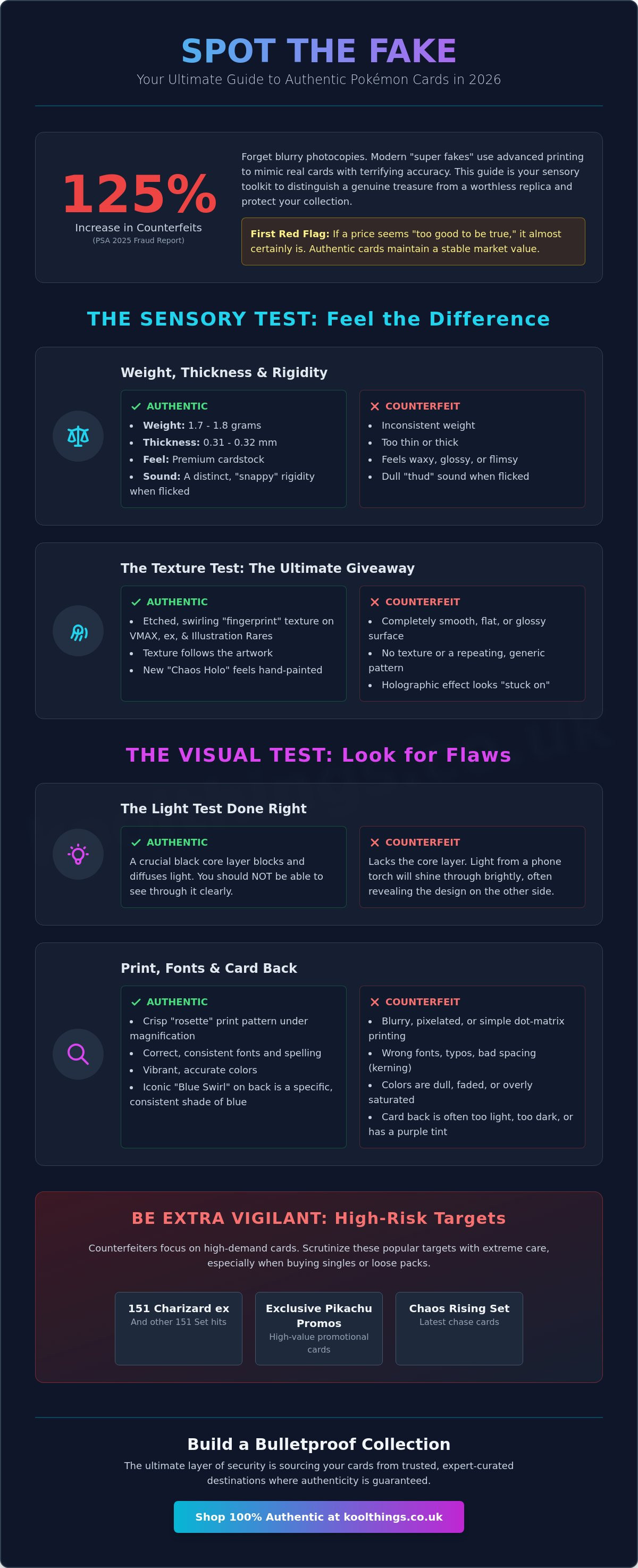
Let's talk specs. As of May 2026, a genuine card weighs between 1.7 and 1.8 grams. It measures exactly 0.31 to 0.32 millimeters in thickness. Fakes often feel waxy or suspiciously flimsy because they lack the high-quality cardstock and that crucial black core layer. When you flick the edge of a real card, it has a distinct, snappy rigidity. A fake? It usually thuds. If you're building a high-value collection, investing in a digital scale and a pair of calipers is a pro move. It's the only way to get a definitive verdict on those "super fakes" that look perfect to the naked eye.
Mastering the Texture Check
Texture is the ultimate giveaway for modern VMAX, GX, and Illustration Rare cards. Authentic cards feature a "fingerprint" of etched, swirling patterns that follow the artwork. The new "Chaos Rising" set, released on May 22, 2026, introduced the "Chaos Holo texture." It has a dynamic, hand-painted feel that's incredibly difficult to forge. Fakes usually have a completely smooth, glossy finish. If the surface is flat where there should be ridges, it's a counterfeit. You can see the difference even more clearly using a digital microscope to check for the "rosette" print pattern, a signature of professional offset lithography. It's a truly kool detail that scammers just can't nail.
The Light Test Done Right
Grab your smartphone. Turn on the torch. Hold the card up to the light. Authentic cards are built like a sandwich with an opaque inner layer. This construction blocks the majority of the light. Counterfeits often use cheaper, thinner cardstock that allows a significant amount of "bleed-through." You'll see the artwork from the other side glowing through the paper. According to TCGplayer's authentication guide, checking for these inconsistencies in card stock is one of the most reliable ways to spot a fake before you commit to a purchase.
Don't risk your hard-earned cash on suspicious listings. For cards that are guaranteed authentic and hand-picked by experts, check out the latest Pokemon arrivals at Koolthings. We handle the vetting so you can focus on the fun.
Visual Red Flags: Fonts, Colours, and the Back of the Card
Eyes on the ink. While the sensory tests we covered earlier expose many "super fakes," the visual details are where the most sophisticated counterfeiters often trip up. Even in 2026, recreating the exact colour profile and typography of an official Pokemon card is a nightmare for unofficial factories. They rely on scans. Scans lose data. That loss of data manifests as "fuzzy" edges, dull colours, and font errors that a savvy collector can spot in seconds. Learning how to tell if pokemon cards are fake requires you to become an arbiter of print quality.
Spelling errors are the classic "tell," and surprisingly, they still appear. A "Ninetales" spelled with two "l"s or a missing accent on the "é" in Pokémon are instant giveaways. Beyond the typos, look at the energy symbols. On authentic cards, these symbols are crisp, vibrant, and perfectly centered within their circles. Fakes often show misalignment or a "bleeding" effect where the ink oversteps its bounds. It looks amateurish. It looks wrong. If the design feels like a low-resolution screenshot, it probably is.
Decoding the Card Back
The back of a Pokemon card is a masterpiece of complex design. It features a sharp, multi-tonal swirl of deep blues and vibrant purples. Most counterfeiters fail here. Their versions often look washed out or use a singular, flat shade of blue that lacks the "pop" of the original. Hold a suspect card next to a confirmed authentic one. The difference in colour saturation is usually striking. Pay close attention to the borders too. Fakes are notoriously off-centre on the back. While official cards can have centering issues, the extreme "thin on one side, thick on the other" look is a hallmark of rushed, unofficial production.
Font and Text Inconsistencies
Kerning is king. This refers to the specific spacing between letters. Counterfeiters often use "close-enough" fonts that result in letters being too cramped or awkwardly far apart. Look closely at the "HP" value and the attack descriptions. If the font looks thinner, thicker, or just "off" compared to a card you know is real, you have found a fake. The "HP" text on a real card is a very specific, bold weight that is difficult to replicate perfectly. Curators at Koolthings always look for these micro-details. We ensure every Pokemon card in our collection passes this rigorous visual inspection. Don't let a "fuzzy" scan ruin your collection; demand the crispness of the real deal.
The High-Risk List: Charizard, Pikachu, and 151 Fakes
Counterfeiters follow the hype. They target the icons. If you are hunting for the biggest hits of the decade, your guard must be up. The 151 set remains the primary target for 2026 scammers. Specifically, the Charizard ex Special Illustration Rare #199. It is the holy grail of modern Kanto collecting. Knowing how to tell if pokemon cards are fake in this high-stakes category is the difference between a legendary pull and a costly mistake. Scammers are no longer just printing paper; they are trying to replicate the soul of the hobby.
It is not just the new stuff either. The "Moonbreon" (Umbreon VMAX) from Evolving Skies remains one of the most dangerous replicas in circulation. These "super fakes" often pass the light test but fail under a microscope. Even vintage Base Set Shadowless cards are seeing a resurgence in high-quality counterfeits. Scammers are now using aged paper stocks to mimic that 1999 feel. These "grails" require more than a casual glance. They require a forensic approach to ensure your investment is secure.
Targeted Checks for 151 Charizard ex
Look at the flames. On an authentic #199, the holographic pattern interacts with the artwork in a specific, swirling motion. The texture has a "flow" that moves with the direction of the wings. Fakes often have static, vertical texture lines or, in many cases, no texture at all. Check the card number at the bottom left. Scammers frequently use the wrong font weight here. It should be crisp, thin, and perfectly legible. If it looks blocky, bold, or slightly blurry, walk away. The centering on these high-value fakes is often "perfect," which is actually a red flag for a set known for its slight factory shifts.
The Pikachu Promo Problem
The "Grey Felt Hat" Van Gogh Pikachu is a magnet for fraud. Check the seal first. Authentic promos have a very specific, high-clarity plastic seal that doesn't feel "crunchy" or oversized. Look at the holofoil stars. On a real Pikachu promo, those stars dance and disappear when you tilt the card. On a fake, they are often printed directly onto the image, staying static regardless of the light angle. Always verify the card number against official set lists. If you want to skip the stress of the hunt, you can find verified, authentic Pokemon English – 151 – Booster Packs and singles at Koolthings. We curate the best so you don't have to worry about the rest.
Mastering how to tell if pokemon cards are fake means knowing these specific vulnerabilities. Whether it is the intricate texture of a Moonbreon or the specific blue hue of a Shadowless Blastoise, the details are your best defense. Stay sharp. Stay curated. Keep your collection real.
Building a Bulletproof Collection with Koolthings
Mastering the art of spotting fakes is your armor. But even the sharpest eye needs a reliable source. The Wild West of unverified marketplaces is a minefield. Scammers hide behind burner accounts and vague photos. They list "super fakes" that mimic the 1.7 gram weight of 2026 releases perfectly. Why take the risk? Choosing an independent UK specialist like Koolthings is your ultimate defense. We don't just move inventory. We curate an experience for those who value individuality and high-quality aesthetics. Your collection deserves better than a "maybe."
The Koolthings Promise is built on transparency. Every item in our collection is a hand-picked choice. We understand the frustration of conflicting online advice on how to tell if pokemon cards are fake. That is why we do the heavy lifting for you. Our experts verify the "Chaos Holo texture" on new hits and the print quality of every vintage single. You get the thrill of the pull without the fear of the fraud. We are your knowledgeable friend who is always ahead of the curve. We possess a sharp eye for both design and utility, ensuring your hobby remains a joy.
Expert Curation Over Mass-Market Chaos
We treat every Pokemon English – 151 – Booster Pack as if it were for our own collection. Our verification process is rigorous. We check factory seals for the correct clarity and tension. We inspect the "Blue Swirl" on card backs to ensure the colour saturation is vibrant, not washed out. This isn't mass-market retail; it is a destination for collectors who demand the real deal. Plus, our trusted UK delivery service ensures your items arrive fast and secure. Peace of mind is the new standard in 2026. We strip away the technical jargon and focus on the tactile feeling of quality.
Next Steps for Your Collection
Ready to level up? Browse our latest verified Pokemon drops today. We are constantly moving forward, looking for the next major development in the TCG world. If you're a multi-fandom collector, check out our guide on Funko Pop Steve Harrington for more expert tips on protecting your shelf. Sign up for our newsletter to stay ahead of the curve on new releases and fraud alerts. Get the latest on Chaos Rising pull rates and immediate updates on new counterfeit trends. Stay savvy. Stay curated. Keep your collection 100% authentic with a brand that rebels against the mundane.
Secure Your Collection and Level Up
Now you have the pro secrets. You know the Chaos Holo texture isn't just a pattern; it is a tactile fingerprint. You understand that a 1.7 gram weight is the difference between a legendary grail and a garbage replica. Mastering how to tell if pokemon cards are fake is your ticket to a collection that holds its value and its soul. Don't let the market's noise distract you from the thrill of a genuine pull. Your journey as a savvy curator starts with trusting your senses and choosing the right partners.
Stop guessing. Start collecting with confidence. We are a family-run, independent UK business dedicated to the 5-star rated collector community we have built together. Every item in our shop is expert-verified and hand-picked to ensure you never have to settle for anything less than perfection. It is a truly kool way to build a legacy. Whether you are hunting for the latest 151 drops or a specific promo, we have your back. High-quality aesthetics and authenticity are just a click away.
Shop 100% Authentic Pokemon Cards at Koolthings
Let's keep the hobby pure and your shelves looking legendary. Happy hunting.
Frequently Asked Questions
Can a fake Pokemon card have texture?
Yes, modern "super fakes" now feature printed texture to mimic high-rarity hits. However, these patterns usually feel grainy or uniform. They lack the "flow" of authentic cards where the etching follows the specific artwork. If the texture looks like a simple, repeating grid rather than a dynamic design, it is a major red flag.
Is the "rip test" a good way to tell if a card is fake?
Absolutely not. The rip test is a destructive relic of the past that ruins your potential investment. You are looking for a thin black ink layer inside the cardstock, but you can spot this layer on the edge of the card using a jeweler's loupe instead. Keep your cards intact. Use the non-destructive sensory guides we've mastered to protect your collection's value.
What is the "light test" and does it work on all cards?
The light test involves shining a bright torch through the card to check for an opaque inner core. It works best on standard common or energy cards. It is less reliable for modern Special Illustration Rares because their thick foil and texture layers naturally block light. Don't rely on this as your only method for high-value hits in 2026.
Are all Pokemon cards from China fake?
Not at all. Official Simplified Chinese Pokemon cards are a legitimate and vibrant part of the hobby. The confusion stems from unofficial factories in the same region that produce mass-market counterfeits. Always check for the official copyright info and compare the holographic patterns to verified Chinese releases before dismissing a card based on its origin.
How can I tell if a Pokemon booster pack has been resealed?
Check the top and bottom crimps for signs of melting or uneven patterns. Authentic packs have a specific, machine-pressed seal that is nearly impossible to replicate with a hand-sealer. If you see tiny holes, sticky residue, or "air bubbles" near the seams, the pack has likely been tampered with. Stick to trusted sources to avoid this trap.
What should I do if I accidentally bought a fake Pokemon card?
Stop and document everything immediately. Take high-resolution photos of the inconsistencies you've found and contact the seller or marketplace to request a refund. Most major platforms have strict buyer protection for counterfeit goods. Reporting these listings helps keep the community safe and ensures scammers don't stay under the radar.
Do fake Pokemon cards have a different weight than real ones?
Yes, weight is a massive giveaway because fakes use cheaper, less dense paper stock. While a real card consistently sits between 1.7 and 1.8 grams, fakes often fluctuate wildly outside this range. Using a digital scale is one of the most objective ways to understand how to tell if pokemon cards are fake without causing any damage.
Why does my authentic card look off-centre?
Centering issues are actually quite common in genuine packs due to factory cutting variations. A card with one border thicker than the other isn't automatically a fake; it is often just a result of inconsistent quality control. Look for other red flags like font errors, dull colours, or a lack of texture before you decide a card is a counterfeit.