

Pokemon Card Condition Guide UK: Grade Your Collection Like a Pro in 2026
That "Near Mint" grail in your hand is probably a "Lightly Played" heartbreak waiting to happen. It's a brutal truth in the hobby. Most collectors look for reasons to keep a card at Mint. The pros? They look for every reason to downgrade it. You've likely spent hours squinting at holo surfaces under a desk lamp, terrified that a single micro-scratch will tank your resale value. With Pokemon officially the #1 toy property in the UK and seeing 45% year-on-year growth, the stakes for your collection have never been higher.
We know the struggle. The line between Near Mint and Lightly Played feels impossibly thin, and the fear of over-grading when selling is real. Our pokemon card condition guide uk is here to turn that anxiety into absolute confidence. It's a curate-first masterclass designed to sharpen your eye. We're stripping away the confusing jargon to deliver a punchy, expert look at identifying flaws. We'll preview the exact traits of Mint and Played cards, show you how to spot hidden surface wear, and get you ready for the UK market standards of 2026.
Key Takeaways
- Learn to distinguish between Flawless Mint and the Near Mint gold standard to ensure your trade values are always accurate.
- Master pro-level detection techniques like the LED light test and the black background trick to expose hidden surface scratches.
- Use this pokemon card condition guide uk to stay ahead of 2026 market trends and the local obsession with pack-fresh quality.
- Identify specific modern quirks, including how UK humidity causes foil curling and how to evaluate texture on Special Illustration Rares.
- Discover the essential double-sleeve method to safeguard your high-value hits against the elements and handling wear.
Why Condition is Everything for UK Collectors
Condition is the heartbeat of the UK hobby. It's the thin line between a £5 piece of cardboard and a £500 trophy. In 2026, the UK market has evolved. Collectors aren't just looking for cards; they're hunting for perfection. With Pokemon now the top toy property in the country, seeing a massive 45% year-on-year growth, every "hit" from a Pokemon English – 151 – Booster Pack is a potential investment. But that investment only holds weight if the condition is flawless. You need to know exactly what you're holding before you list it or sleeve it.
Self-assessment is your first line of defense. Before you ever consider sending your cards to professional grading services, you need to be your own harshest critic. This pokemon card condition guide uk helps you bridge the gap between "looks okay" and "Gem Mint". Conditioning isn't just about the flip. It's about preserving TCG history. You're a curator, not just a seller. Every scratch you miss is a hit to your reputation and your wallet. Understanding the nuances of wear is how you level up from a casual fan to a savvy collector.
The Value Hierarchy
Market prices are sensitive. A single white speck on a corner can slash a card's value by 30% or more. "Mint" is often used as a marketing claim, but condition is a measurable fact. There’s a psychological rush to pulling a pristine card. It feels different. It looks sharper. When you hold a card with zero imperfections, you're holding a survivor. It represents the peak of what the hobby offers, and the UK market is currently obsessed with this "Pack Fresh" standard.
Raw Card Standards in 2026
The UK trend has shifted toward ultra-picky modern collecting. "Near Mint" is the most disputed term in the hobby right now. One person's Near Mint is another person's Lightly Played. Beyond scratches, centering is the new king of "eye appeal". A card can have perfect surfaces but poor centering, which ruins the aesthetic balance. Modern sets have high standards. Collectors expect sharp corners and vibrant colors. With the PSA UK office opening in 2026, the barrier to entry for grading is lower. This means raw cards are scrutinized even more heavily. If it isn't a candidate for a high grade, the market price reflects that reality immediately.
The Koolthings Grading Scale: From Pack Fresh to Heavily Played
Grading is a vibe, but the scale is a science. You need a framework that removes the guesswork. This pokemon card condition guide uk uses a standardized hierarchy to help you categorize your hits with surgical precision. Whether you are looking at a vintage holo or a fresh pull from a Pokemon English – 151 – Booster Pack, the rules remain the same. It is all about the details that the naked eye often misses. High-tempo collecting requires high-tempo evaluation. Let's break down the levels.
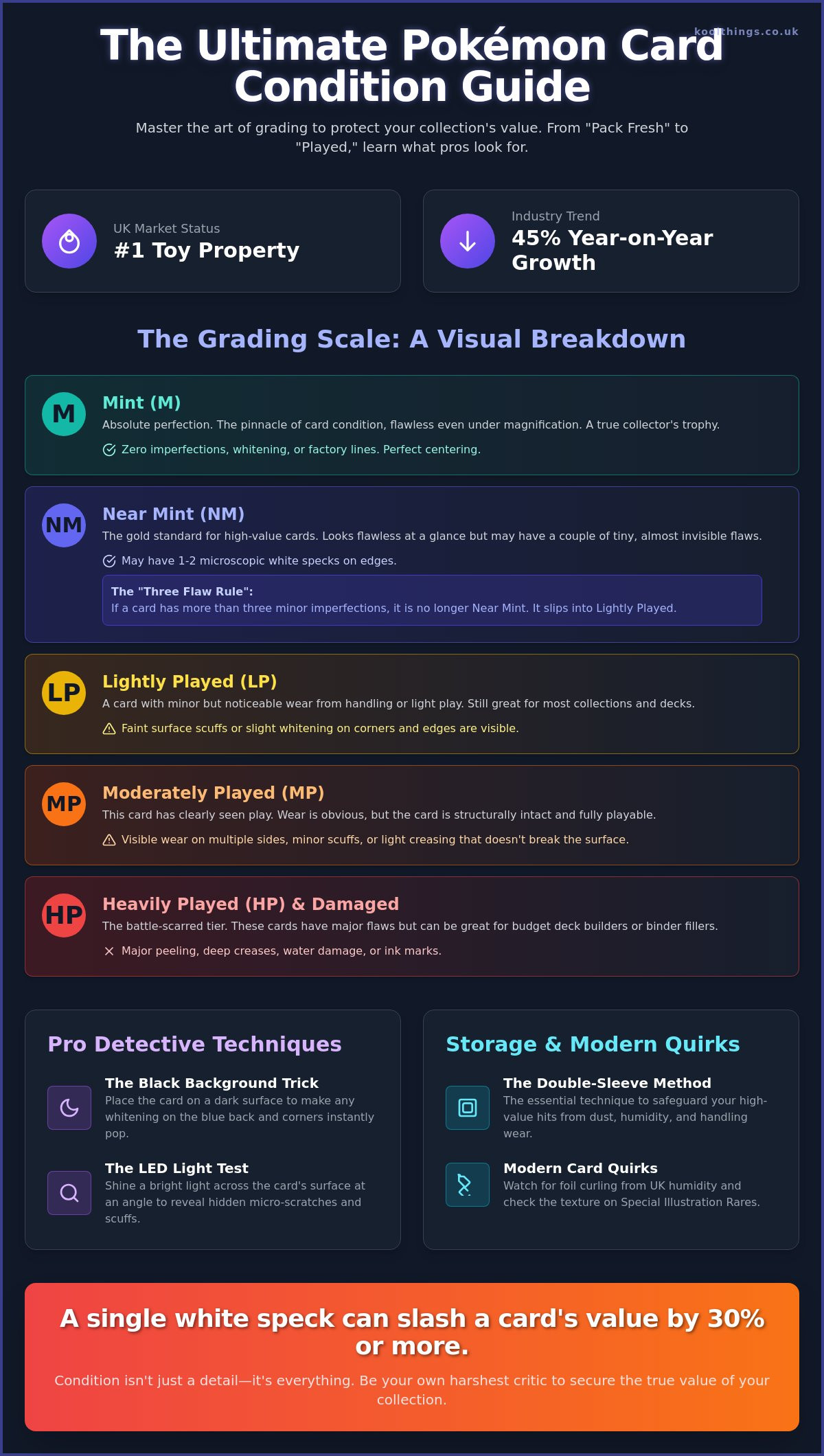
- Mint (M): Absolute perfection. Zero imperfections under a jeweler's loupe. No factory lines, no whitening, and perfect centering.
- Near Mint (NM): The gold standard for most collectors. It looks flawless at a glance, but might hide one or two microscopic specks or a tiny touch of silvering on an edge.
- Lightly Played (LP): Minor handling is visible. You might see faint surface scuffs or slight whitening on the corners of the blue back.
- Moderately Played (MP): This card has seen some action. Expect visible wear, whitening on multiple sides, or very light creasing that doesn't break the surface.
- Heavily Played (HP) & Damaged: The battle-scarred tier. Major peeling, water damage, deep creases, or ink marks. These are for the binder, not the display case.
When you align your collection with the PSA Grading Standards, you're speaking the language of the global market. It’s about being honest with yourself and your buyers. If you're looking to add some guaranteed heat to your personal vault, check out our latest Pokemon drops to see what true pack-fresh quality looks like.
Spotting the "Near Mint" Boundary
The "Three Flaw Rule" is your best friend here. Generally, if a card has more than three minor imperfections, it’s no longer Near Mint. It slips into Lightly Played territory. Always flip the card over. The blue back is where "whitening" loves to hide. Even a factory-fresh card can be "only" Near Mint if the cutting blades at the factory were dull, leaving tiny white nicks along the edges. Perfection is rare; that’s why it’s valuable.
Understanding "Played" Conditions
Played cards have their own charm, especially for those building competitive decks. A Lightly Played card is usually still tournament-legal in a sleeve. Watch out for "surface clouding". This is a dullness on the holo foil caused by thousands of tiny micro-scratches from sliding across a table. It's the silent killer of card value. However, don't toss a "Damaged" card if it's a rare grail. A creased first-edition Charizard still holds significant historical weight for the right curator.
The Detective Work: Spotting Surface Wear and Soft Corners
Stop looking at your cards under normal living room lights. It’s the amateur’s biggest mistake. If you want to master the pokemon card condition guide uk, you need to adopt a detective’s mindset. Harsh, direct LED lighting is your best friend. It acts as a truth serum for cardboard. While soft ambient light hides micro-scratches, a focused beam reveals every scuff and swipe on that holo surface. It's about seeing what others miss.
Try the black background trick. Place your card on a dark, non-reflective surface like a black playmat. Suddenly, edge whitening that looked invisible against a white table pops with aggressive clarity. It’s a game-changer for evaluating the blue back of the card. For those truly hunting for Gem Mint status, a 10x jeweler’s loupe is non-negotiable. It transforms a "clean" corner into a landscape of fuzzy fibers or sharp factory cuts. Contrast is king when you're hunting for perfection.
Don't forget the tilting method. Hold the card at a 45-degree angle and slowly rotate it under your light source. This is the only way to catch "hidden" flaws like micro-indentations or dimples. These flaws don't always break the ink, but they ruin the surface grade instantly. It’s about catching the light at the exact moment it hits an imperfection. If you aren't tilting, you aren't grading.
Corner and Edge Analysis
Sharp corners are the hallmark of a "Pack Fresh" hit. If the corners look "fuzzy" or rounded, the card has seen friction. In older UK holo sets, you’ll often see "silvering". This is where the foil peeks through the front edges. While it’s a factory defect, it still impacts the grade. Chipping along the edges tells the card’s life story. It shows it wasn't sleeved immediately after being pulled from a Pokemon English – 151 – Booster Pack. Every white nick is a reminder of poor storage.
Surface Scrutiny
Holographic surfaces are magnets for damage. Learn to distinguish between a "swirl" and a scuff. A swirl is a rare, desirable factory pattern. A scuff is owner damage. Print lines are another hurdle. These are straight, horizontal or vertical lines from the factory. They aren't your fault, but they still downgrade the card in the eyes of pro-graders. Dents and dimples are often the most heartbreaking. They usually happen during handling or from being trapped in a dirty sleeve. Use that 45-degree tilt to ensure the light catches every dip in the surface. If the surface isn't smooth, it isn't Mint.
Special Handling: Holos, Reverse Foils, and Modern Set Quirks
Modern cards aren't built like the vintage grails of the 90s. The manufacturing process has changed, and so have the flaws. If you are using this pokemon card condition guide uk, you need to understand that "Pack Fresh" doesn't always mean Mint. Modern sets introduce unique quirks like complex textures and sensitive reverse holo finishes. UK collectors face a specific environmental challenge: humidity. Our damp climate is the primary cause of "foil curling," where the card bows into a U-shape. This happens because the metallic foil layer and the paper cardstock react differently to moisture. It’s a condition killer that you must manage with proper storage.
Texture is the new frontier of grading. When you pull a Special Illustration Rare, the surface should feel like a topographic map. These intricate ridges are essential for authenticity and condition. With pull rates for these hits sitting at approximately 1 in 12 packs in 2026, the stakes are massive. Any smoothing of this texture suggests surface wear or handling damage. Reverse holos are even more temperamental. Their flat, shiny surfaces show scuffs if you even look at them wrong. They are arguably the hardest cards in a modern set to keep in a true Mint state.
The 151 Collector Guide
The English release of the Pokemon English – 151 set is a masterclass in nostalgia, but it’s also a minefield of factory defects. Print lines are the most common heartbreak. These horizontal or vertical "rungs" appear across the holographic field. While they come straight from the factory, they still prevent a card from reaching the highest grades. Centering is another hurdle. The specific border design of this set makes even a 60/40 shift look glaringly obvious. If you want to start your 151 journey with the best possible odds, pick up a Pokemon English – 151 – Booster Pack and check for these factory quirks the moment you crack the seal.
Foil Preservation
Clouding is the silent enemy of the holo-lover. It’s a dull, foggy film caused by microscopic dust trapped inside a sleeve. Over time, these particles act like sandpaper against the foil. You also need to watch for the "Rainbow Effect". Genuine modern foils have a specific, sharp light refraction. If the rainbow looks muddy or "flat," the surface might be degraded. If you find your cards "Pringling" due to UK weather, don't panic. You can often restore them by using silica gel packets in a sealed container to pull out the excess moisture, followed by a period under a heavy, flat weight.
Level Up Your Storage: Keeping Your Hits in Mint Condition
Identifying a flaw is only half the battle. Preventing one is where the real skill lies. This pokemon card condition guide uk isn't just about spotting scratches; it's about building a fortress for your collection. If you've managed to pull a Special Illustration Rare, you're holding a 1 in 12 rarity. Don't let a cheap sleeve ruin it. The double-sleeve method is your best defense. Slide a tight-fitting "perfect fit" sleeve over the top of the card first, then place that into a standard penny sleeve with the openings at opposite ends. This creates a literal air-tight seal against dust and UK humidity.
Binder choice can make or break a long-term investment. Avoid the old-school three-ring binders. They are notorious for "ring sight," a nasty indentation caused by the rings pressing into the cards near the spine. Switch to side-loading binders with fixed pages and D-rings. They keep the pressure even and prevent cards from sliding out. Since Pokemon is currently the #1 toy property in the UK with 45% year-on-year growth, your storage choices today define your portfolio's value in 2030. High-tempo collecting requires high-spec protection.
Climate control is the final boss. The UK’s damp weather is a nightmare for holographic foil. Keep your collection away from external walls where moisture can seep in. Avoid direct sunlight at all costs. UV rays will bleach the vibrant ink of a modern hit in months. Store your binders in a cool, dry, dark place. Use silica gel packets in your storage boxes to soak up excess moisture. It’s a simple, low-tech fix that saves you from the "Pringle" effect we discussed earlier.
Essential Gear for Curators
Chemistry matters. Always verify that your sleeves and pages are acid-free and PVC-free. Cheap plastics release gases over time that can "melt" the card surface or cause yellowing. When it comes to rigid protection, use toploaders for display and semi-rigids for grading submissions. Semi-rigids are the preferred choice for the new PSA UK office opening in 2026 because they minimize card movement during shipping. It's about using the right tool for the specific job.
The Koolthings Way
We don't just move inventory; we curate culture. Every item we stock is a hand-picked choice designed to elevate your aesthetic. Whether you are chasing the thrill of unboxing a pristine Pokemon English – 151 – Booster Pack or hunting for that final piece of your master set, we've got you. Join our community of savvy collectors and share your latest grading wins. We’re ahead of the curve, and we want you right there with us. Stay sharp, stay Mint, and keep hunting.
Master the Grade and Secure Your Legacy
You've got the tools. You've got the eye. Mastering the nuances of surface wear and factory defects isn't just about selling; it's about respecting the art of the TCG. By applying the techniques from this pokemon card condition guide uk, you've moved past the "looks okay" stage. You're now a curator who understands why a sharp corner and a scratch-free holo field define the elite tier of the hobby. From the LED light test to the double-sleeve method, your collection is now protected by pro-level standards.
Now it's time to put that sharp eye to work. Whether you're hunting for a flawless chase card or starting a fresh binder, we've got your back. As a family-run independent UK shop, we pride ourselves on expertly curated pop culture merchandise that meets your high standards. We offer fast national UK shipping so your next big pull arrives exactly when the hype is peak. Explore our curated Pokemon collection and grab your next 151 Booster Pack! The hunt for the next Gem Mint trophy starts right now. Go find your grail.
Frequently Asked Questions
What does "Near Mint" actually mean for Pokemon cards in the UK?
Near Mint (NM) means the card is nearly flawless but allows for one or two tiny specks of whitening or a microscopic surface scratch. It is the gold standard for high-end raw collectors. If you spot more than three minor flaws, the card usually drops into Lightly Played territory immediately.
Can a card straight from a booster pack be considered "Damaged"?
Yes, factory errors can occasionally classify a pack-fresh card as Damaged or heavily flawed. Severe crimping from the packaging machine or deep surface gouges can happen before the pack is even sealed. It is rare, but it is a reality of mass production that every curator should watch for.
How do I spot a fake Pokemon card vs. a poorly conditioned one?
Spotting a fake requires looking at texture and light refraction rather than just wear. Genuine modern hits have intricate, tactile textures that you can feel with a fingernail. Fakes usually feel smooth and have a dull, vertical light shine. This pokemon card condition guide uk helps you spot wear, but authenticity is about the print quality.
Does whitening on the back of a Pokemon card lower its grade?
Whitening on the back is a major grade killer. Even if the front is perfect, white nicks on the blue borders will tank your final score. Grading companies look at the card as a 360-degree object. The back often tells the real story of how a card was handled or stored over the years.
What is "silvering" on older Pokemon cards?
Silvering is a specific type of edge wear where the holographic foil shows through the front borders. It was a common factory quirk in vintage UK sets like Jungle or Fossil. While some collectors find it nostalgic, it technically counts as an imperfection during a professional evaluation and will prevent a Gem Mint grade.
Are "print lines" considered damage when grading my collection?
Print lines are treated as surface defects. Even though you did not cause them, they disrupt the visual flow of the artwork and the holographic field. Most grading scales will cap a card's grade if prominent horizontal or vertical lines are visible, as they ruin the "eye appeal" of the piece.
How should I store my cards to prevent curling in the UK?
Prevent curling by using silica gel packets in air-tight storage containers to fight the local humidity. The UK's damp air is the primary enemy of holographic foil. Double-sleeving provides an extra layer of defense by locking out moisture. It keeps your cards flat and your investment secure for the long term.
Is it worth grading a card that has visible scratches?
Grading a scratched card is only worth it for high-value "grails" or iconic vintage pieces where a low grade still carries prestige. For modern cards, a visible scratch usually makes the grading fee more expensive than the card's final market value. Focus your grading budget on cards that have a real shot at a 9 or 10.