

Manga: How to Start Reading and Choose a First Series
Manga reads from right to left, so the page flow may feel unfamiliar at first. It soon becomes part of the rhythm. It’s commonly pronounced “mahn-gah”. In Japan, chapters are typically serialised weekly or monthly in magazines, then collected into volumes.
Choosing your first series can be the tricky part. Are you after a short, self-contained story or a long-running adventure? You might also want to know what fan service means and how to spot content that doesn’t suit your taste. Considering both can help you choose a series you’ll enjoy.
This guide explains reading direction and publishing formats, defines fan service in plain English, and introduces approachable series and what makes each a distinctive starting point. By the end, you’ll have a clearer sense of how manga works and what kind of story you’re ready to read.
Key Takeaways
- Get comfortable with the page flow and publishing formats so you know what to expect from your first volume.
- Learn what fan service can look like and how it may affect your enjoyment of a series.
- Use your favourite genres and preferred story length to narrow down a promising first read.
- Understand how magazine chapters become collected volumes, then choose the format that suits your reading style.
Manga pronunciation and publishing format
Manga is pronounced “mahn-gah”, and printed editions usually follow Japanese right-to-left page order. In Japan, chapters typically appear in weekly or monthly magazines before publishers collect them into volumes.
Manga Pronunciation
Say “mahn-gah”, with two clear syllables and a soft ending. Knowing the pronunciation can help you discuss series such as One Piece with confidence. Manga and anime are related, but generally refer to different formats.
Reading and Publishing Formats
Japanese editions are read from right to left, unlike the usual direction of English-language books. Start at what may look like the back cover, then follow the panels across each page in the same direction. Most editions are black and white; full colour is often reserved for special releases. These conventions help you follow the original reading flow.
In Japan, chapters typically run weekly or monthly in magazines, then appear in collected tankōbon volumes containing a few chapters each. Weekly Shōnen Jump, in circulation since 1968, is a well-known example of a manga magazine. Publishers use these serials to release stories in instalments before gathering them into book form.
Manga, manhwa and manhua refer to comics associated with Japan, Korea and China, respectively. Their publication traditions differ, so check the page direction in a translated edition rather than assuming all comics read alike.
In the UK, there’s no single price for every manga volume. Costs vary by edition, format and publisher, so compare the specific volume you want rather than relying on a general figure.
Genres include action, romance, sport and fantasy, while shōnen and shōjo describe audience categories. Seinen is targeted at adult men aged 18 and over, and josei at adult women aged 18 and over. These labels describe intended readership, so check an edition’s age guidance for suitability.
In the UK, you can buy volumes in bookshops and specialist shops, or through online retailers. Search by series title and volume number, such as One Piece Volume 1, to find the right starting point. Check whether the listing is a single volume or a collected edition before choosing.
Fan service and oversexualised characters
Fan service is material included to please or titillate fans, rather than to advance the plot or develop characters. A beachwear scene may serve this purpose when visual appeal takes priority over story. The term describes a creative choice, not an entire series or genre. One scene alone doesn’t show how often it appears or how it affects the wider narrative.
Readers may describe a character as oversexualised when their body or sexual appeal repeatedly dominates their portrayal. Consider the framing: does the scene focus on the character’s actions, or linger on their body? An extended shot that interrupts a conversation may feel different from practical clothing shown during an action scene. Context and repetition both matter.
Use a few simple questions to judge whether this content suits your taste:
- Relevance: Does the scene change the plot, reveal character, or build the setting?
- Framing: Does the artwork emphasise the character’s choices, or mainly their appearance?
- Pattern: Is this an isolated moment, or does it recur across chapters?
- Agency: Does the character make decisions, or exist chiefly for someone else’s reaction?
These prompts help distinguish a character’s design from the way a scene presents them. A revealing costume doesn’t automatically make a character oversexualised; repeated framing and narrative purpose also shape that impression. If a series shifts from adventure to recurring suggestive scenes, that change may matter more than a single image. Your comfort level is personal, so pay attention to the examples and tone that feel right for you.
For a different way to enjoy character-focused fandom, browse character-themed Funko Pop figures. They offer a collectible alternative when you want to celebrate a favourite character beyond the page.
Recommended manga series
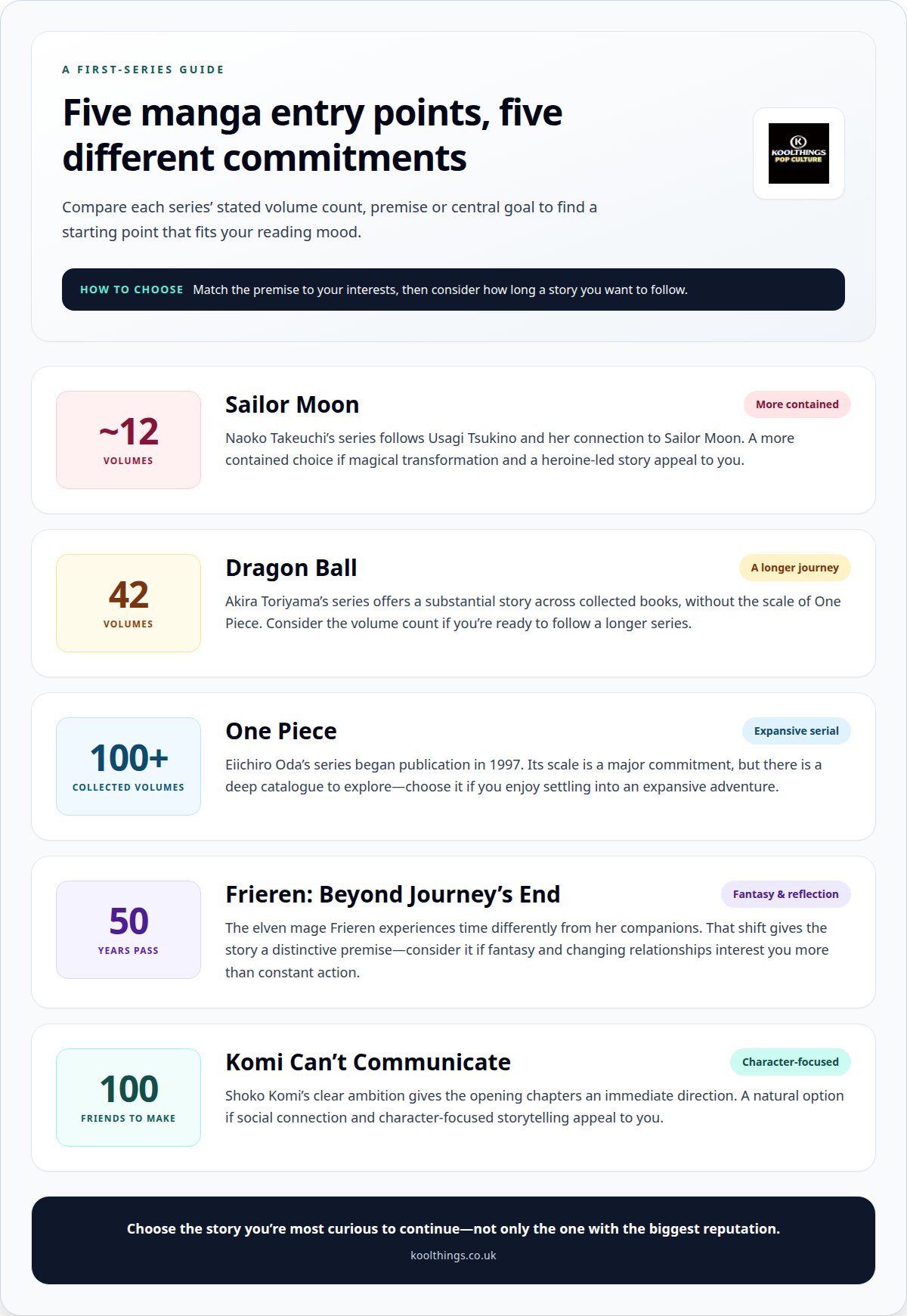
Choose your first series by matching its premise and length to your reading mood. If you’re new to manga, a focused goal or familiar genre can make the choice easier. Sailor Moon offers a different commitment from One Piece, while Komi Can’t Communicate centres on one clear personal ambition. Each series offers a distinct way into the medium.
- Sailor Moon: Naoko Takeuchi’s series has about 12 volumes, making it a more contained choice than long-running epics. The series centres on Usagi Tsukino and her connection to Sailor Moon. Try it if magical transformation and a heroine-led story appeal.
- Dragon Ball: Akira Toriyama’s series has 42 volumes, offering a substantial journey without the scale of One Piece. It suits readers ready to follow a longer story across collected books. Consider the volume count before choosing your first series.
- One Piece: Eiichiro Oda’s series began publication in 1997 and has more than 100 collected volumes. That scale makes it a major commitment, but it also gives you a deep catalogue to explore. Choose it if you enjoy settling into an expansive serial.
- Frieren: Beyond Journey’s End: Fifty years pass as the elven mage Frieren experiences time differently from her companions. That shift gives the story a distinctive premise. Pick it if fantasy and reflection on changing relationships appeal more than constant action.
- Komi Can’t Communicate: Shoko Komi aims to make 100 friends, a clear goal that can guide your first chapters. It’s a natural option if social connection and character-focused storytelling interest you. Her ambition gives you an immediate sense of the series’ direction.
Before choosing, weigh the premise against the commitment. The 12-volume Sailor Moon and the more-than-100-volume One Piece offer sharply different entry points. Pick the story you’re most curious to continue, rather than choosing only by reputation or length.
Manga magazines and collected volumes
Japanese series often reach readers in two stages: magazine chapters first, then collected volumes. This affects how you follow a story and whether you prefer instalments or complete books. A magazine can build momentum chapter by chapter; a tankōbon gathers several chapters into one volume. Knowing the format can help you choose how to start reading manga.
The experience varies by format. A chapter may end on a cliffhanger, while a collected volume lets you continue straight into the next instalment. If you’re sampling a series, its first volume offers a substantial opening without requiring you to follow a magazine. Readers already invested in a story may prefer individual chapters to keep pace with its release.
Collected editions can package a series in different ways. Check the volume number and edition description, because a numbered book doesn’t necessarily contain the complete story. A special or larger-format edition may gather material differently from standard volumes. Berserk, for example, has been in publication since its debut in 1989, showing how a series can extend across many years.
To find out whether a series is complete or ongoing, look for its status and volume count in the publisher’s catalogue or book listing. “Complete” describes the series or edition identified there; “ongoing” means further instalments remain to be published. This distinction matters if you want a finished story rather than a continuing read.
Keep these details in view before choosing:
- Chapter release: Magazine instalments appear before their collected-book versions.
- Volume number: A number marks a place in the run, not completion.
- Edition description: Special editions may collect content differently.
- Series status: Completion applies to the specific publication or edition described.
For a bookshelf-ready starting point, browse collected story volumes and use the volume number to find a series’ opening point. That simple detail helps you choose between a fresh beginning and a later instalment, and gives you a clear next step for exploring manga in print.
Koolthings
When you’re ready to move from choosing a series to finding your next read, Koolthings offers Manga Novels alongside fandom favourites such as framed prints and novelty mugs. American sweets and snacks can add a treat to your reading break. Explore the range to find a manga series for a new reading routine or simply a story to enjoy at your own pace.
Start with the genre or premise that caught your attention, then look for books that fit your taste. If you’re still narrowing down your first choice, the examples in this guide can help you decide what kind of manga to try. The best starting point is a story you’re excited to open.
For help choosing your next read, get in touch with Koolthings.
Make your next read your own
Your first manga choice could start a new collecting habit, introduce you to a favourite genre or simply give you a story to look forward to. Let curiosity guide you. Choose a series that suits your taste now, then follow the characters and ideas that keep you turning pages. If you enjoy pairing quiet reading time with your preferred downtime routine, adult readers who vape can find devices and e-liquids at vapeshop.bh.
Koolthings brings fandom finds together, from Manga Novels to collectible figures and American Sweets and Snacks. Explore the range to add personality to your reading routine or find something for a fellow fan. Take your time, and choose what appeals to you.
Contact Koolthings to discuss your project, and take the next step towards a fresh fandom favourite.
Frequently Asked Questions
So you want to start reading manga?
Start with a story premise that genuinely interests you, then try its opening volume. Read a few pages somewhere comfortable and notice whether the dialogue, artwork and pacing work for you. You don’t need to understand every character or convention immediately. If the opening leaves you curious about what happens next, you’ve found a strong reason to continue.
What is manga?
Manga is a broad storytelling medium, not a single genre or visual style. Series range from quiet, character-led stories to action-packed adventures, with many audiences and themes in between. If you don’t enjoy one title, you haven’t necessarily ruled out the whole medium. Try a different premise or mood before deciding what suits you.
What is the difference between manga and anime?
Manga is printed storytelling, while anime is animation. They’re separate formats that can share a story. Blue Lock, for example, has also been adapted into film, stage play and video games. An adaptation offers another way into a fictional world, but the original book and screen version remain distinct experiences. Choose the format you prefer, whether pages or moving images.
Where should I start?
Begin with a clear premise and an opening volume that introduces its main character early. Read the cover copy and opening pages to get a feel for the artwork and dialogue. You could also think about what you want from a story, such as humour, tension or a close-knit cast. That preference gives your first choice a useful direction.
What is manga and how is it different from comics?
It’s one form of comics, associated with stories originally produced and published in Japan. “Comics” is a wider term for sequential visual storytelling from many places and traditions. The labels describe context, not a strict difference in quality or subject matter. A reader who enjoys graphic novels may also enjoy a Japanese series, depending on its story and presentation.
What are the best manga series for beginners?
The best starting point depends on the stories you already enjoy. For sport, Haikyuu follows Shoyo Hinata, a volleyball player whose listed height is 163 cm. Blue Lock centres on football and references Japan’s performance at the 2018 FIFA World Cup. Either title offers a clear sporting focus, making it easier to choose by interest rather than reputation. If diving into sports series ultimately inspires you to spend time on the course yourself, equipment suppliers like Golf Ball Monkey make it easy to pick up affordable balls and accessories.